which statement is true about the end behavior of the graphed function? as the x - values go to positive…
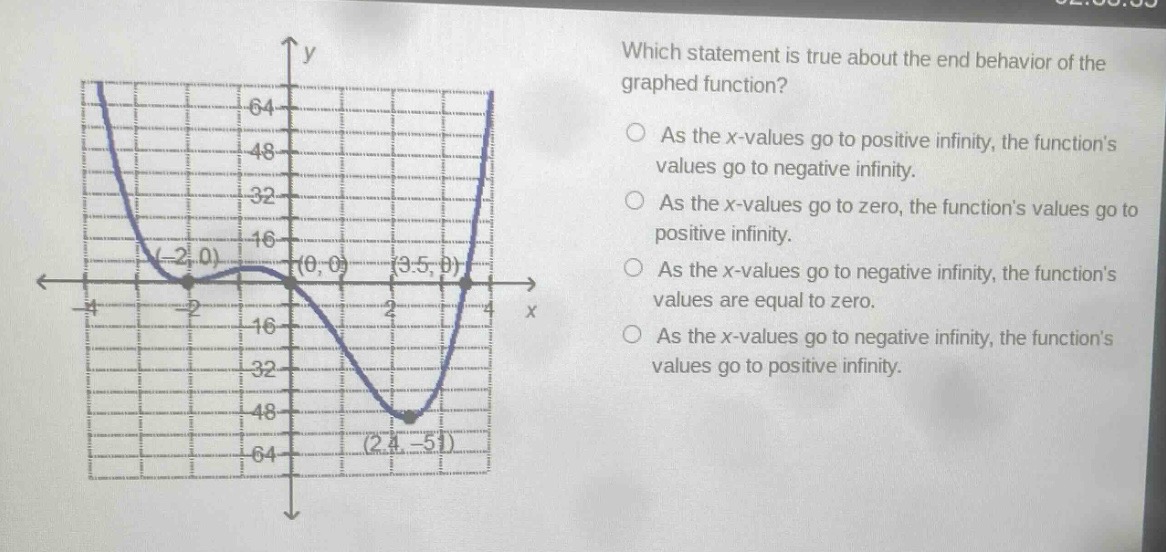
which statement is true about the end behavior of the graphed function? as the x - values go to positive infinity, the functions values go to negative infinity. as the x - values go to zero, the functions values go to positive infinity. as the x - values go to negative infinity, the functions values are equal to zero. as the x - values go to negative infinity, the functions values go to positive infinity.
Answer
Explanation:
Step1: Analyze the end - behavior as (x\to+\infty)
Looking at the right - hand side of the graph, as (x) gets larger and larger (i.e., (x\to+\infty)), the (y) - values of the function increase. So, as (x\to+\infty), (y\to+\infty). This means the first option “As the (x) - values go to positive infinity, the function’s values go to negative infinity” is false.
Step2: Analyze the behavior as (x\to0)
When (x = 0), the function value (y = 0) (from the point ((0,0)) on the graph). So, the statement “As the (x) - values go to zero, the function’s values go to positive infinity” is false.
Step3: Analyze the end - behavior as (x\to-\infty)
Looking at the left - hand side of the graph, as (x) gets more and more negative (i.e., (x\to-\infty)), the (y) - values of the function increase. The function values do not approach (0) as (x\to-\infty). The third option “As the (x) - values go to negative infinity, the function’s values are equal to zero” is false.
Answer:
As the (x) - values go to negative infinity, the function’s values go to positive infinity.