which statement is true about the end - behavior of the graphed function?\nas the x - values go to positive…
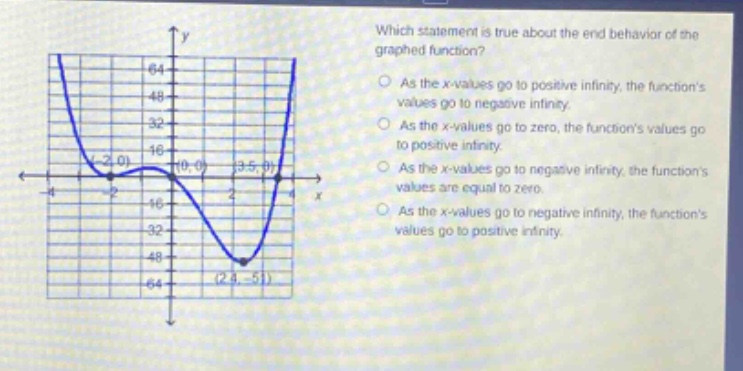
which statement is true about the end - behavior of the graphed function?\nas the x - values go to positive infinity, the functions values go to negative infinity.\nas the x - values go to zero, the functions values go to positive infinity.\nas the x - values go to negative infinity, the functions values are equal to zero.\nas the x - values go to negative infinity, the functions values go to positive infinity.
Answer
Explanation:
Step1: Analyze right - hand end behavior
As (x\to+\infty), looking at the graph, the function values increase. The function values go to positive infinity.
Step2: Analyze left - hand end behavior
As (x\to-\infty), looking at the graph, the function values increase. The function values go to positive infinity.
Step3: Analyze behavior near (x = 0)
Near (x = 0), the function value is (0) (since the graph passes through ((0,0))).
Step4: Check each option
- Option 1: As (x\to+\infty), function values go to positive infinity, not negative infinity, so this is false.
- Option 2: As (x\to0), function value is (0), not positive infinity, so this is false.
- Option 3: As (x\to-\infty), function values go to positive infinity, not equal to (0), so this is false.
- Option 4: As (x\to-\infty), the function's values go to positive infinity, this is true.
Answer:
As the (x) - values go to negative infinity, the function's values go to positive infinity.