which statement can be true about the function represented in the table? the function has a relative minimum…
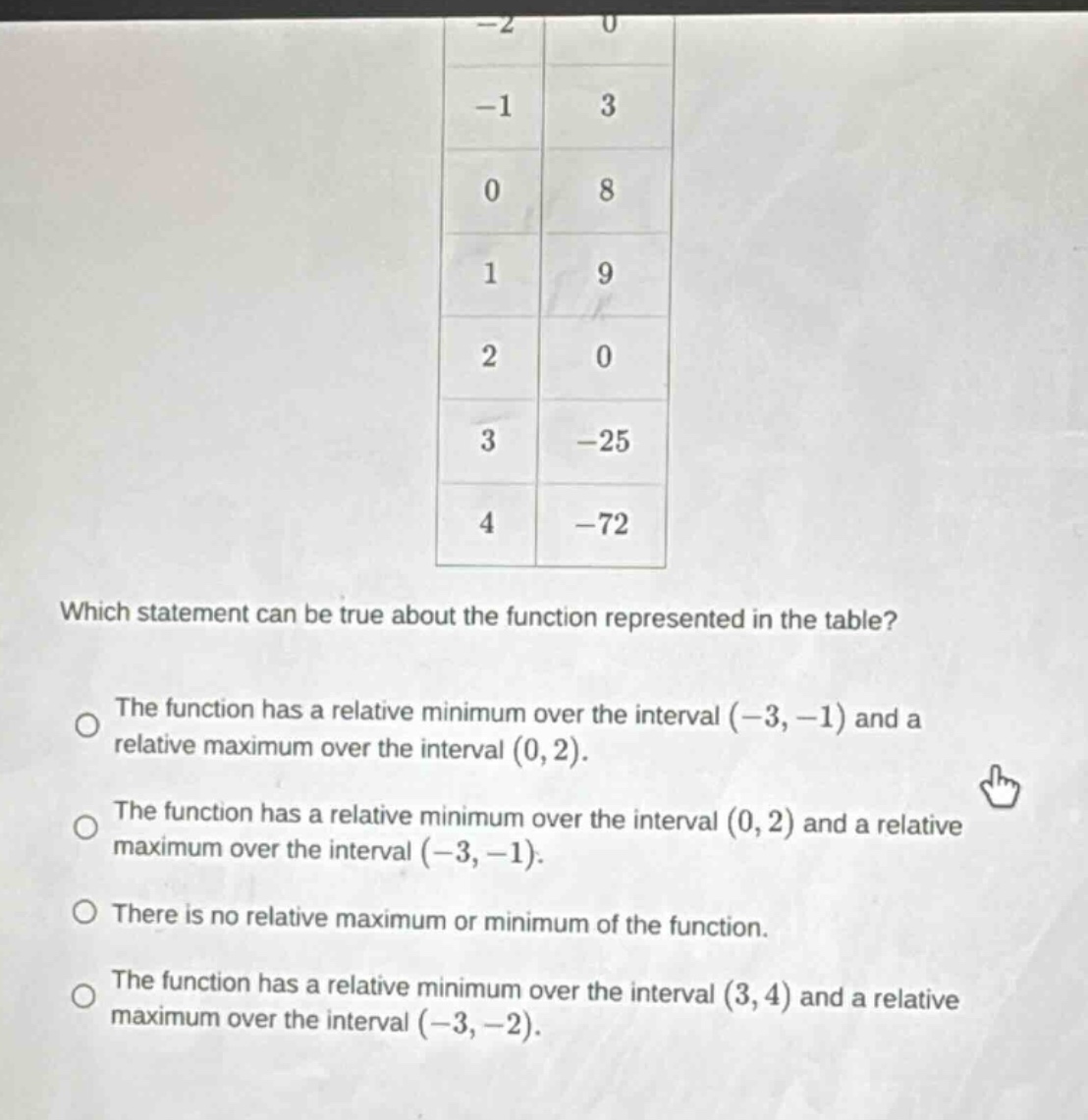
which statement can be true about the function represented in the table? the function has a relative minimum over the interval (-3, -1) and a relative maximum over the interval (0, 2). the function has a relative minimum over the interval (0, 2) and a relative maximum over the interval (-3, -1). there is no relative maximum or minimum of the function. the function has a relative minimum over the interval (3, 4) and a relative maximum over the interval (-3, -2).
Answer
Explanation:
Step1: Understand relative - extrema concept
A relative minimum is a point where the function changes from decreasing to increasing, and a relative maximum is a point where the function changes from increasing to decreasing.
Step2: Analyze the function values in intervals
For (x=-1), (y = 3); for (x = 0), (y=8); for (x = 1), (y = 9); for (x=2), (y = 0). The function is increasing from (x=-1) to (x = 1) ((3) to (9)) and then decreasing from (x = 1) to (x=2) ((9) to (0)), so there is a relative maximum in the interval ((0,2)). Also, considering the general trend before (x=-1) (not given full - interval ((-3,-1)) but from the values we have), and the fact that the function value at (x=-1) is (3) and at (x = 0) is (8), it is likely that the function has a relative minimum in the interval ((-3,-1)).
Answer:
The function has a relative minimum over the interval ((-3,-1)) and a relative maximum over the interval ((0,2)).