which statement is true about the given function?\n○ ( f(x)>0 ) over the interval ((-infty,3)).\n○ ( f(x)>0…
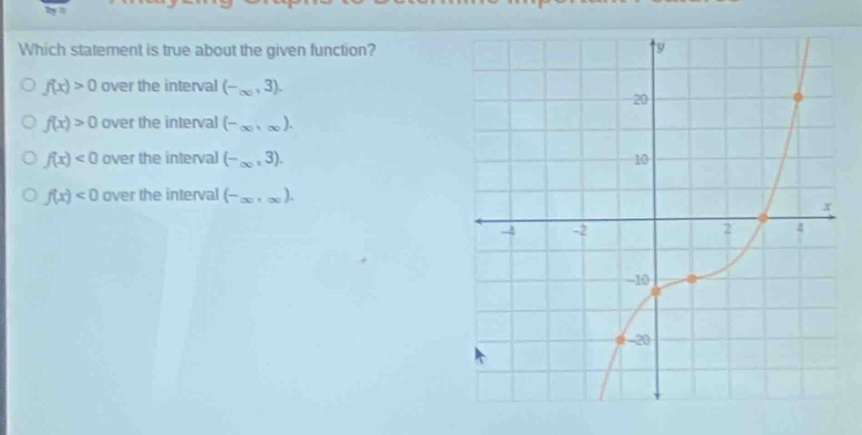
which statement is true about the given function?\n○ ( f(x)>0 ) over the interval ((-infty,3)).\n○ ( f(x)>0 ) over the interval ((-infty,infty)).\n○ ( f(x)<0 ) over the interval ((-infty,3)).\n○ ( f(x)<0 ) over the interval ((-infty,infty)).
Answer
Explanation:
Step1: Analyze the graph
Observe the y - values of the function for different x - values.
Step2: Check the interval $(-\infty,3)$
For $x\in(-\infty,3)$, some parts of the graph are below the x - axis (where $y = f(x)<0$) and some parts are above the x - axis (where $y = f(x)>0$).
Step3: Check the interval $(-\infty,\infty)$
The graph has parts above and below the x - axis. It is not always positive or always negative over $(-\infty,\infty)$.
Step4: Determine the correct statement
By looking at the graph, we can see that $f(x)<0$ over some sub - intervals of $(-\infty,3)$. But overall, $f(x)$ is not always positive or negative over $(-\infty,3)$ or $(-\infty,\infty)$. However, we can see that $f(x)<0$ for some values in $(-\infty,3)$.
Answer:
$f(x)<0$ over the interval $(-\infty,3)$ is the correct statement among the given options.