which statement is true about the given function?\n○ (f(x)>0) over the interval ((-infty,3)).\n○ (f(x)>0)…
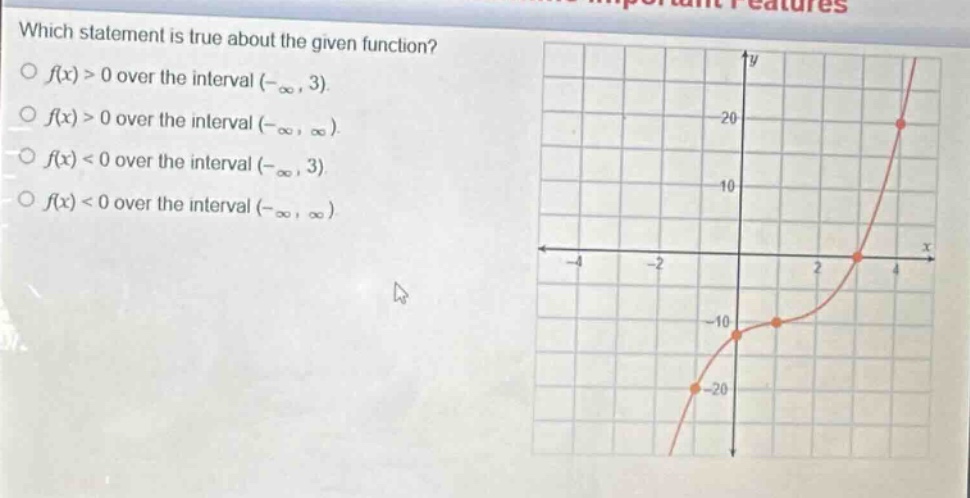
which statement is true about the given function?\n○ (f(x)>0) over the interval ((-infty,3)).\n○ (f(x)>0) over the interval ((-infty,infty)).\n○ (f(x)<0) over the interval ((-infty,3)).\n○ (f(x)<0) over the interval ((-infty,infty))
Answer
Explanation:
Step1: Analyze the graph
Observe the function's position relative to the x - axis.
Step2: Check intervals
For (x\in(-\infty,3)), part of the function is below the x - axis ((y = f(x)<0)) and part is above. For (x\in(-\infty,\infty)), the function is not always above or below the x - axis. Looking at the graph, we can see that for (x\in(-\infty,3)), (f(x)) is negative for some values and positive for others. But for (x\in(-\infty,\infty)), the function clearly takes both positive and negative values. The function crosses the x - axis at (x = 3). When (x<3), there are points where (f(x)<0) and when (x>3), (f(x)>0).
Answer:
None of the given options are true.