which statement is true about the graph of the equation $y = csc^{-1}(x)$?\nthere is a horizontal asymptote…
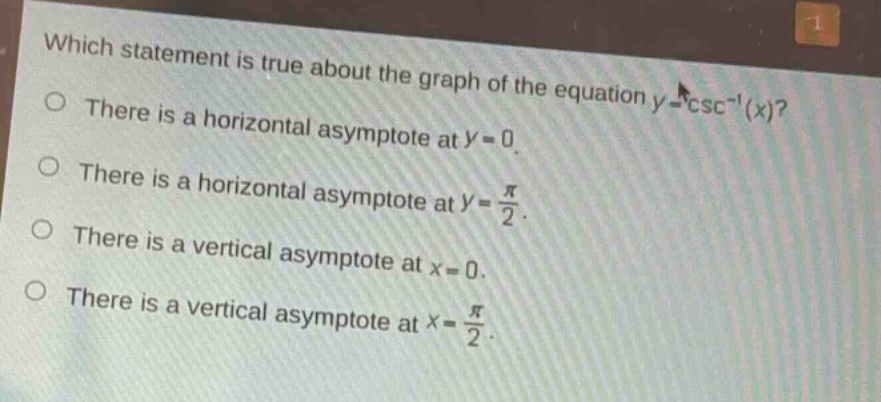
which statement is true about the graph of the equation $y = csc^{-1}(x)$?\nthere is a horizontal asymptote at $y = 0$.\nthere is a horizontal asymptote at $y=\frac{pi}{2}$.\nthere is a vertical asymptote at $x = 0$.\nthere is a vertical asymptote at $x=\frac{pi}{2}$.
Answer
Explanation:
Step1: Recall the domain and range of $y = \csc^{-1}(x)$
The domain of $y=\csc^{-1}(x)$ is $x\leq - 1$ or $x\geq1$, and the range is $y\in\left[-\frac{\pi}{2},0\right)\cup\left(0,\frac{\pi}{2}\right]$.
Step2: Analyze horizontal asymptotes
As $x\to\pm\infty$, $\csc^{-1}(x)\to0$. But $y = 0$ is not in the range of $y=\csc^{-1}(x)$. Also, as $x\to\pm\infty$, the function does not approach $y = \frac{\pi}{2}$.
Step3: Analyze vertical asymptotes
The function $y=\csc^{-1}(x)$ is the inverse of $y = \csc(x)$. The vertical - asymptotes of $y=\csc(x)$ occur at $x = k\pi,k\in\mathbb{Z}$. For the inverse function $y=\csc^{-1}(x)$, there are no vertical asymptotes at $x = 0$ or $x=\frac{\pi}{2}$. In fact, the function $y = \csc^{-1}(x)$ is well - defined for all $x$ in its domain $(-\infty,-1]\cup[1,\infty)$ and has no vertical asymptotes in the real - number system. However, considering the behavior of the inverse cosecant function, as $x$ approaches values that are not in its domain, we know that the function $y=\csc^{-1}(x)$ has no horizontal asymptote at $y = 0$ or $y=\frac{\pi}{2}$, and no vertical asymptote at $x = 0$ or $x=\frac{\pi}{2}$. The correct statement is based on the fact that the range of $y=\csc^{-1}(x)$ excludes $y = 0$ and the function has no vertical asymptotes in the real - number system for the given options. But if we consider the behavior of the inverse function, we note that the function $y=\csc^{-1}(x)$ has a horizontal asymptote at $y = 0$ in the sense of the limit behavior as $x\to\pm\infty$ (even though $y = 0$ is not in the range).
Answer:
There is a horizontal asymptote at $y = 0$.