which statement is true?\nthe graph of ( y = log_{b}(x - 4) ) is the graph of ( y = log_{b}(x) ) translated…
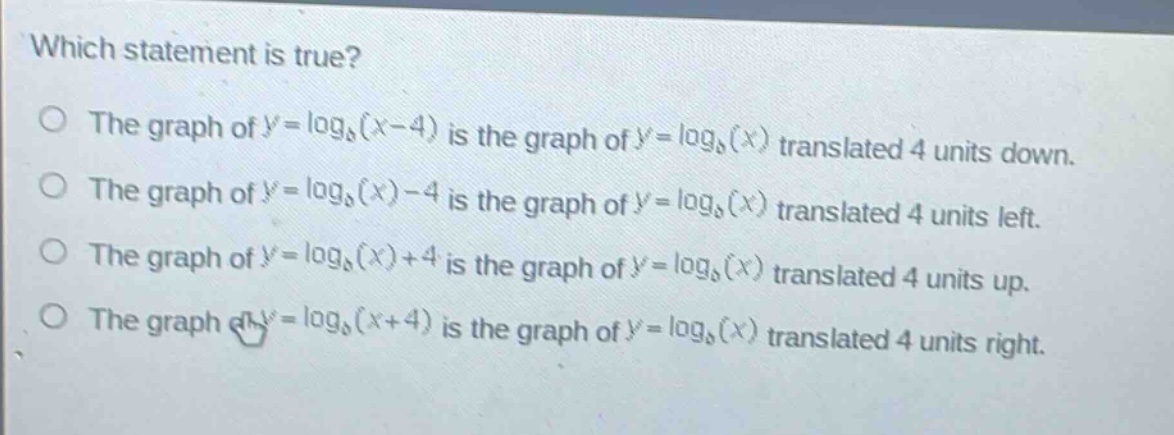
which statement is true?\nthe graph of ( y = log_{b}(x - 4) ) is the graph of ( y = log_{b}(x) ) translated 4 units down.\nthe graph of ( y = log_{b}(x) - 4 ) is the graph of ( y = log_{b}(x) ) translated 4 units left.\nthe graph of ( y = log_{b}(x) + 4 ) is the graph of ( y = log_{b}(x) ) translated 4 units up.\nthe graph of ( y = log_{b}(x + 4) ) is the graph of ( y = log_{b}(x) ) translated 4 units right.
Answer
Explanation:
Step1: Recall the translation rules for functions
For a function (y = f(x)), (y=f(x)+k) is a vertical translation. If (k>0), it is a translation (k) units up. If (k < 0), it is a translation (|k|) units down. (y = f(x - h)) is a horizontal translation. If (h>0), it is a translation (h) units to the right. If (h<0), it is a translation (|h|) units to the left.
Step2: Analyze each option
- For (y=\log_b(x - 4)), using the rule (y = f(x - h)) with (f(x)=\log_b(x)) and (h = 4), it is a translation 4 units to the right (not 4 units down).
- For (y=\log_b(x)-4), using the rule (y=f(x)+k) with (k=- 4), it is a translation 4 units down (not 4 units left).
- For (y=\log_b(x)+4), using the rule (y=f(x)+k) with (k = 4), it is a translation 4 units up.
- For (y=\log_b(x + 4)), using the rule (y = f(x - h)) with (h=-4), it is a translation 4 units to the left (not 4 units right).
Answer:
The graph of (y=\log_b(x)+4) is the graph of (y = \log_b(x)) translated 4 units up.