which statement is true about the graphed function f(x)? o f(x) < 0 over the intervals (-∞, -2.5) and…
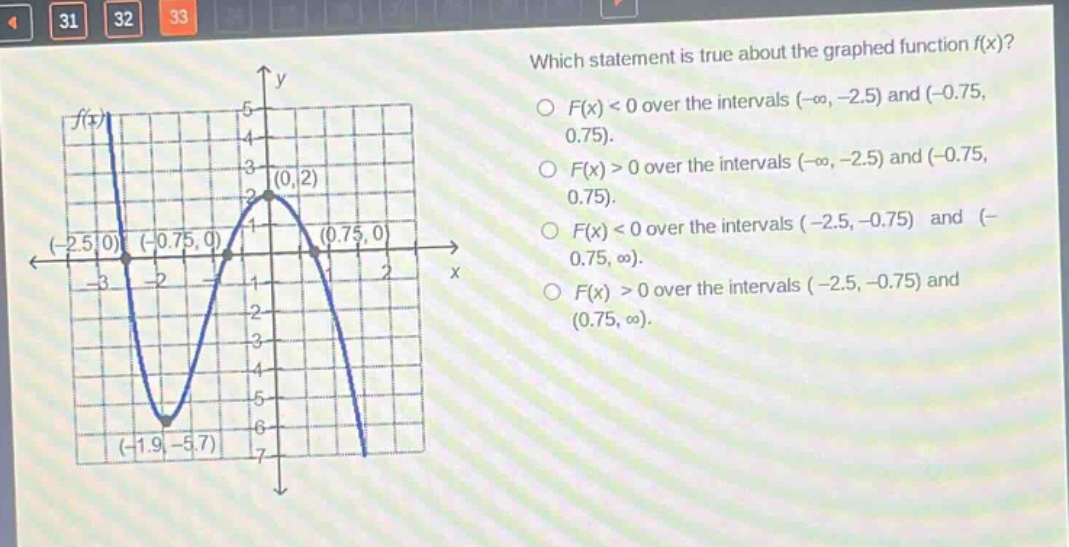
which statement is true about the graphed function f(x)? o f(x) < 0 over the intervals (-∞, -2.5) and (-0.75, 0.75). o f(x) > 0 over the intervals (-∞, -2.5) and (-0.75, 0.75). o f(x) < 0 over the intervals (-2.5, -0.75) and (-0.75, ∞). o f(x) > 0 over the intervals (-2.5, -0.75) and (0.75, ∞).
Answer
Explanation:
Step1: Understand function values
The function (y = f(x)) is negative when the graph is below the (x -)axis and positive when above the (x -)axis.
Step2: Identify negative - value intervals
The graph of (y = f(x)) is below the (x -)axis over the intervals ((-\infty,- 2.5)) and ((-0.75,0.75)). So (f(x)<0) over these intervals.
Answer:
(F(x)<0) over the intervals ((-\infty,-2.5)) and ((-0.75,0.75))