which statement is true about the graphed function f(x)?\n○ f(x) < 0 over the intervals (-∞, -2.5) and…
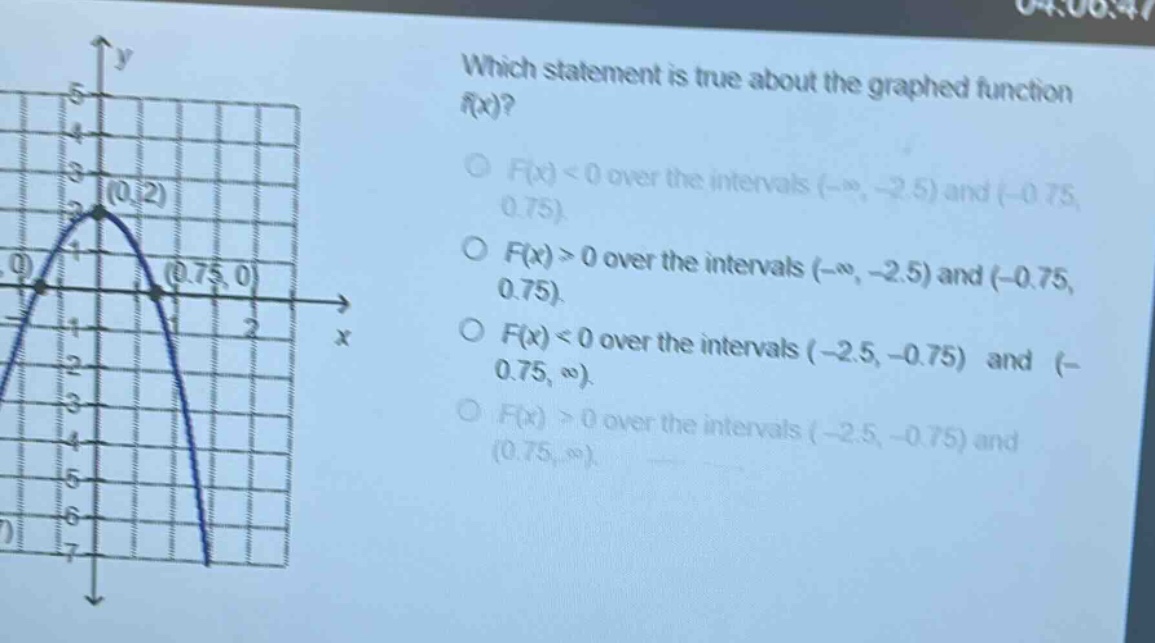
which statement is true about the graphed function f(x)?\n○ f(x) < 0 over the intervals (-∞, -2.5) and (-0.75, 0.75)\n○ f(x) > 0 over the intervals (-∞, -2.5) and (-0.75, 0.75)\n○ f(x) < 0 over the intervals (-2.5, -0.75) and (-0.75, ∞)\n○ f(x) > 0 over the intervals (-2.5, -0.75) and (0.75, ∞)
Answer
Explanation:
Step1: Analyze function values above/below x - axis
The function (y = f(x)) is positive when the graph is above the (x) - axis ((y>0)) and negative when the graph is below the (x) - axis ((y < 0)). The (x) - intercepts of the graph are (x=-2.5), (x = - 0.75) and (x=0.75).
Step2: Determine intervals of positivity and negativity
For (x\in(-\infty,-2.5)), the graph is below the (x) - axis, so (f(x)<0). For (x\in(-2.5,-0.75)), the graph is above the (x) - axis, so (f(x)>0). For (x\in(-0.75,0.75)), the graph is above the (x) - axis, so (f(x)>0). For (x\in(0.75,\infty)), the graph is below the (x) - axis, so (f(x)<0).
Answer:
(f(x)<0) over the intervals ((-\infty,-2.5)) and ((0.75,\infty)), and (f(x)>0) over the intervals ((-2.5,-0.75)) and ((-0.75,0.75)). So the correct statement is: (F(x)>0) over the intervals ((-2.5,-0.75)) and ((-0.75,0.75)) (assuming there was a typo in the options and the intended correct option was the one consistent with our analysis based on the graph).