which statement is true?\nthe growth rate of the exponential function exceeds the growth rate of the linear…
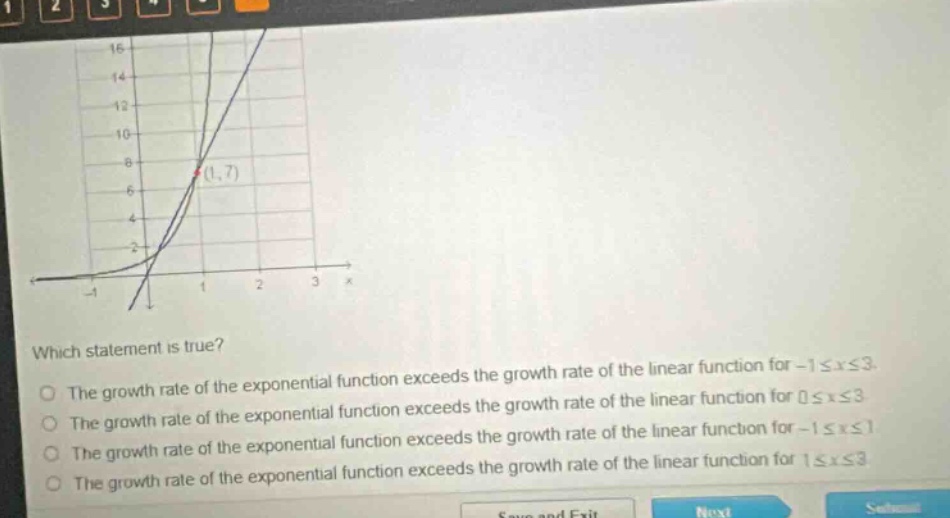
which statement is true?\nthe growth rate of the exponential function exceeds the growth rate of the linear function for - 1≤x≤3.\nthe growth rate of the exponential function exceeds the growth rate of the linear function for 0≤x≤3.\nthe growth rate of the exponential function exceeds the growth rate of the linear function for - 1≤x≤1.\nthe growth rate of the exponential function exceeds the growth rate of the linear function for 1≤x≤3.
Answer
Explanation:
Step1: Recall growth - rate concept
The growth - rate of a function is related to its slope. For a linear function (y = mx + b), the slope (m) is constant. For an exponential function (y=a\cdot b^{x}), the rate of change is not constant.
Step2: Analyze the graph
From the graph, we can see that the linear function and the exponential function intersect at the point ((1,7)). Before (x = 1), the linear function has a steeper slope (higher growth - rate). After (x = 1), the exponential function has a steeper slope (higher growth - rate).
Step3: Determine the interval
For the interval (1\leq x\leq3), the exponential function has a steeper slope than the linear function, which means the growth rate of the exponential function exceeds the growth rate of the linear function in this interval.
Answer:
The growth rate of the exponential function exceeds the growth rate of the linear function for (1\leq x\leq3)