which statement is true? a. on every interval of x - values, the average rate of change of f(x) exceeds the…
which statement is true? a. on every interval of x - values, the average rate of change of f(x) exceeds the average rate of change of g(x). b. on every interval of x - values, the average rate of change of g(x) exceeds the average rate of change of f(x). c. as x increases, the rate of change of g(x) exceeds the rate of change of f(x). d. as x increases, the rate of change of f(x) exceeds the rate of change of g(x).
Answer
Explanation:
Step1: Recall average - rate - of - change concept
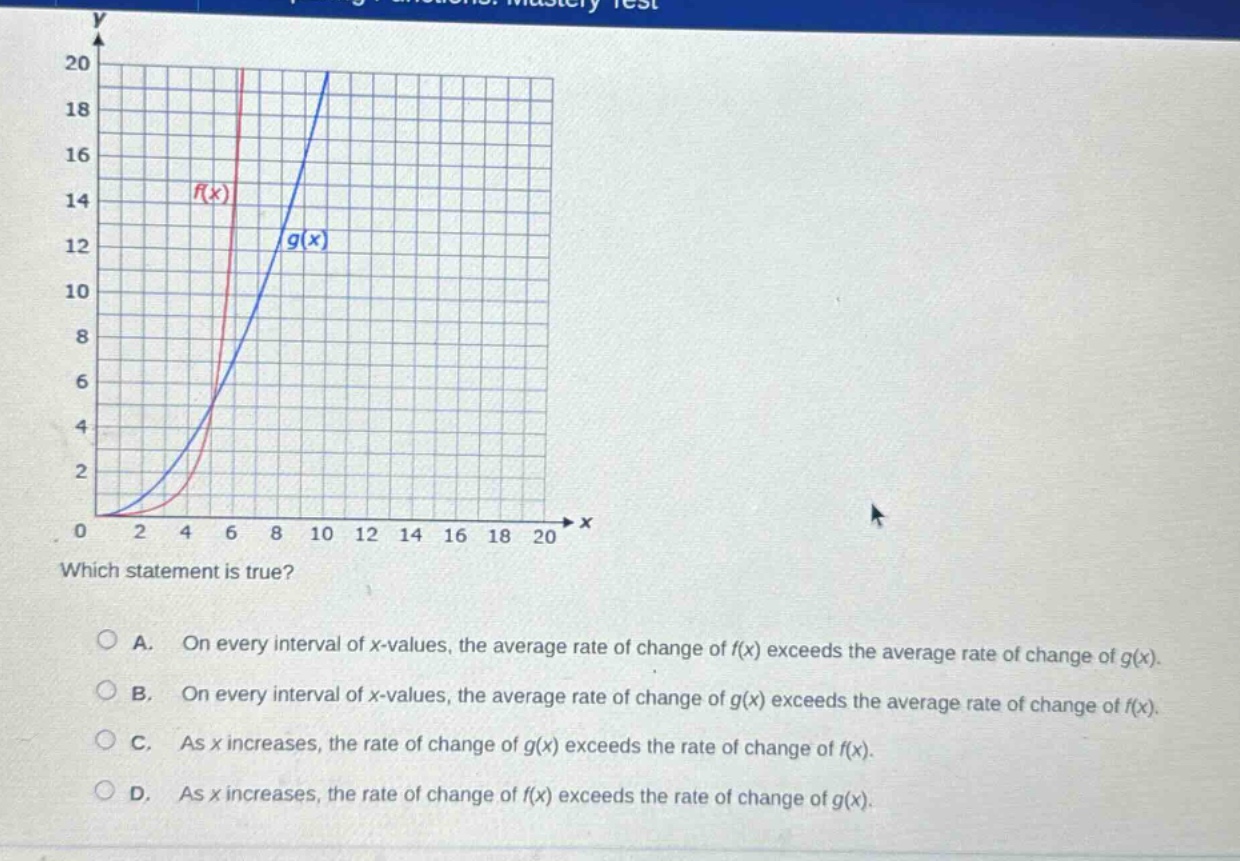
The average rate of change of a function $y = f(x)$ over the interval $[a,b]$ is $\frac{f(b)-f(a)}{b - a}$, which is the slope of the secant line between the points $(a,f(a))$ and $(b,f(b))$. Visually, the steeper the graph of the function over an interval, the greater the average rate of change.
Step2: Analyze the graphs
Looking at the graphs of $f(x)$ and $g(x)$, we can see that for small values of $x$ (e.g., $x\in[0, 4]$), the graph of $f(x)$ is steeper than the graph of $g(x)$, so the average rate of change of $f(x)$ is greater than that of $g(x)$ on this interval. But as $x$ increases (e.g., for $x > 6$), the graph of $g(x)$ becomes steeper than the graph of $f(x)$.
Step3: Evaluate each option
- Option A: It is not true since for $x>6$, the average rate of change of $g(x)$ is greater than that of $f(x)$ on some intervals.
- Option B: It is not true since for $x\in[0,4]$ the average rate of change of $f(x)$ is greater than that of $g(x)$.
- Option C: As $x$ increases, the graph of $g(x)$ gets steeper than the graph of $f(x)$. So, as $x$ increases, the rate of change of $g(x)$ exceeds the rate of change of $f(x)$. This option is correct.
- Option D: This is the opposite of what we observe from the graph as $x$ increases.
Answer:
C. As $x$ increases, the rate of change of $g(x)$ exceeds the rate of change of $f(x)$.