which statement is true for g(x)?\nyou can remove the discontinuity at x = 0 by defining g(0)=0.\nyou can…
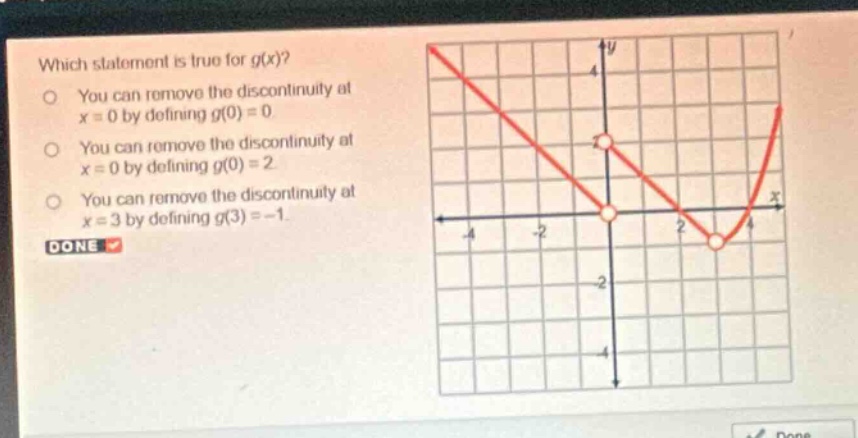
which statement is true for g(x)?\nyou can remove the discontinuity at x = 0 by defining g(0)=0.\nyou can remove the discontinuity at x = 0 by defining g(0)=2.\nyou can remove the discontinuity at x = 3 by defining g(3)= - 1.\ndone
Answer
Answer:
You can remove the discontinuity at (x = 0) by defining (g(0)=2)
Explanation:
Step1: Identify the limit at (x = 0)
As (x) approaches (0) from both left - hand and right - hand sides, the function values approach (y = 2).
Step2: Check the definition for continuity
For a function to be continuous at (x=a), (\lim_{x\rightarrow a}g(x)=g(a)). At (x = 0), to remove the hole (removable discontinuity), we need (g(0)) to be equal to the limit as (x\rightarrow0), which is (2).
Step3: Analyze (x = 3)
As (x) approaches (3), the function values do not approach (- 1), so defining (g(3)=-1) will not remove the discontinuity at (x = 3).