which statements correctly describe the cosine and sine functions? choose four correct answers. both the…
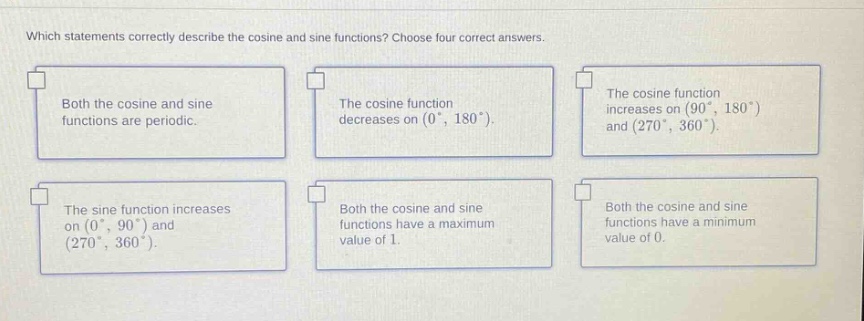
which statements correctly describe the cosine and sine functions? choose four correct answers. both the cosine and sine functions are periodic. the cosine function decreases on (0°, 180°). the cosine function increases on (90°, 180°) and (270°, 360°). the sine function increases on (0°, 90°) and (270°, 360°). both the cosine and sine functions have a maximum value of 1. both the cosine and sine functions have a minimum value of 0.
Answer
Explanation:
Step1: Recall periodicity of trig - functions
The sine function (y = \sin(x)) and the cosine function (y=\cos(x)) have a period of (2\pi) (or (360^{\circ})). So, both the cosine and sine functions are periodic.
Step2: Analyze the behavior of the cosine function
The cosine function (y = \cos(x)) has a derivative (y'=-\sin(x)). On the interval ((0^{\circ},180^{\circ})), (\sin(x)> 0), so (y'=-\sin(x)<0), and the cosine function decreases on ((0^{\circ},180^{\circ})).
Step3: Analyze the behavior of the sine function
The sine function (y = \sin(x)) has a derivative (y'=\cos(x)). On the interval ((0^{\circ},90^{\circ})), (\cos(x)>0), and on the interval ((270^{\circ},360^{\circ})), (\cos(x)>0), so the sine function increases on ((0^{\circ},90^{\circ})) and ((270^{\circ},360^{\circ})).
Step4: Analyze the maximum - value of trig - functions
The range of (y = \sin(x)) and (y=\cos(x)) is ([- 1,1]). So both the cosine and sine functions have a maximum value of (1).
Step5: Analyze the minimum - value of trig - functions
The minimum value of both (y = \sin(x)) and (y=\cos(x)) is (-1), not (0). Also, the cosine function decreases on ((90^{\circ},180^{\circ})) and ((270^{\circ},360^{\circ})) is incorrect as it decreases on ((0^{\circ},180^{\circ})) and increases on ((180^{\circ},360^{\circ})).
Answer:
- Both the cosine and sine functions are periodic.
- The cosine function decreases on ((0^{\circ},180^{\circ})).
- The sine function increases on ((0^{\circ},90^{\circ})) and ((270^{\circ},360^{\circ})).
- Both the cosine and sine functions have a maximum value of 1.