which statements about the graph of the function y = (1/3)^x are true? the function is increasing. the…
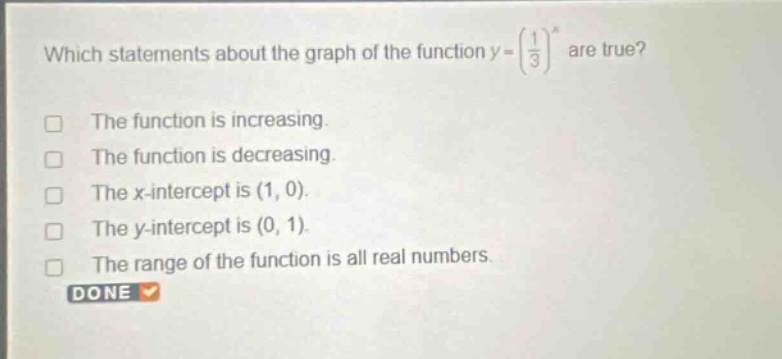
which statements about the graph of the function y = (1/3)^x are true? the function is increasing. the function is decreasing. the x - intercept is (1, 0). the y - intercept is (0, 1). the range of the function is all real numbers.
Answer
Explanation:
Step1: Analyze function form
The function $y = (\frac{1}{3})^x$ is an exponential - function of the form $y = a^x$ where $a=\frac{1}{3}$ and $0 < a<1$.
Step2: Determine increasing/decreasing nature
For an exponential function $y = a^x$, when $0 < a<1$, the function is decreasing. As $x$ increases, $y$ values get smaller. So, the function $y = (\frac{1}{3})^x$ is decreasing.
Step3: Find x - intercept
Set $y = 0$, then $0=(\frac{1}{3})^x$. Since $a^x>0$ for all real $x$ when $a>0,a\neq1$, there is no real - value of $x$ for which $y = 0$. So, there is no $x$ - intercept.
Step4: Find y - intercept
Set $x = 0$, then $y=(\frac{1}{3})^0 = 1$. So, the $y$ - intercept is $(0,1)$.
Step5: Determine range
Since $(\frac{1}{3})^x>0$ for all real $x$, the range of the function $y = (\frac{1}{3})^x$ is $y>0$, not all real numbers.
Answer:
The function is decreasing. The y - intercept is $(0,1)$.