3. which of the statements are true about the function f given by f(x)=100·e^(-x)? select all that…
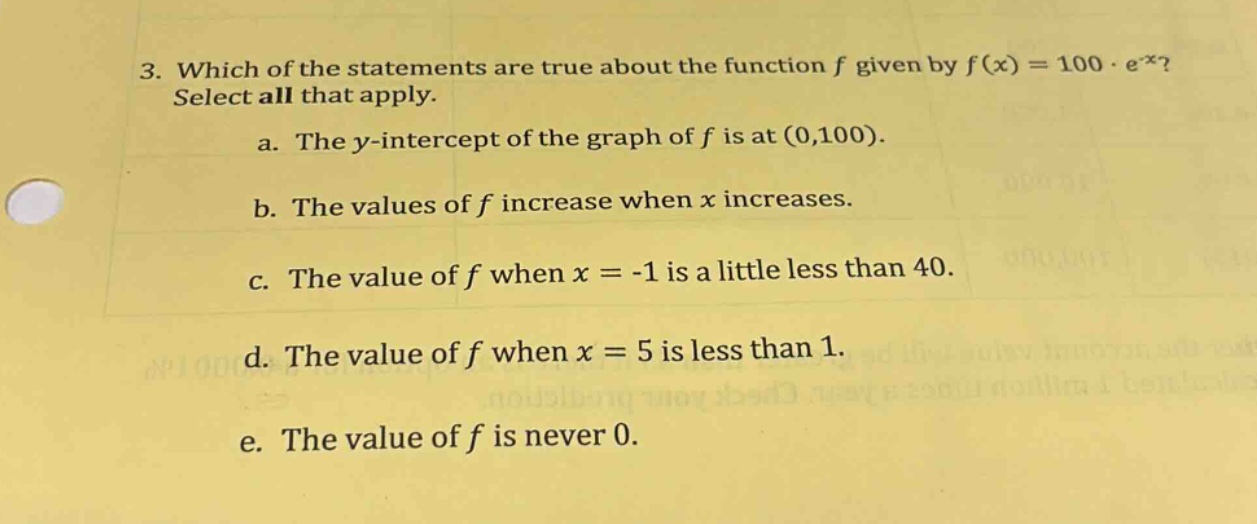
3. which of the statements are true about the function f given by f(x)=100·e^(-x)? select all that apply.\na. the y - intercept of the graph of f is at (0,100).\nb. the values of f increase when x increases.\nc. the value of f when x = - 1 is a little less than 40.\nd. the value of f when x = 5 is less than 1.\ne. the value of f is never 0.
Answer
Explanation:
Step1: Find y - intercept
Set (x = 0) in (f(x)=100\cdot e^{-x}). Then (f(0)=100\cdot e^{0}=100\cdot1 = 100). So the y - intercept is ((0,100)), and statement a is true.
Step2: Analyze the behavior of the function
The function (f(x)=100\cdot e^{-x}=100\cdot(\frac{1}{e})^{x}), where (\frac{1}{e}\approx0.368<1). As (x) increases, ((\frac{1}{e})^{x}) decreases, so (f(x)) decreases. Statement b is false.
Step3: Calculate (f(- 1))
Substitute (x=-1) into (f(x)), (f(-1)=100\cdot e^{-(-1)}=100e\approx100\times2.718 = 271.8). Statement c is false.
Step4: Calculate (f(5))
Substitute (x = 5) into (f(x)), (f(5)=100\cdot e^{-5}=100\cdot\frac{1}{e^{5}}\approx100\times\frac{1}{148.4132}\approx0.674<1). Statement d is true.
Step5: Analyze when (f(x)=0)
Set (f(x)=100\cdot e^{-x}=0). Since (e^{-x}=\frac{1}{e^{x}}>0) for all real - valued (x), then (100\cdot e^{-x}\neq0) for all (x). Statement e is true.
Answer:
A. The y - intercept of the graph of (f) is at ((0,100)) D. The value of (f) when (x = 5) is less than (1) E. The value of (f) is never (0)