which statements are true about the function f(x)=(x - 3)(x + 1)(x - 2)? select all that apply. the function…
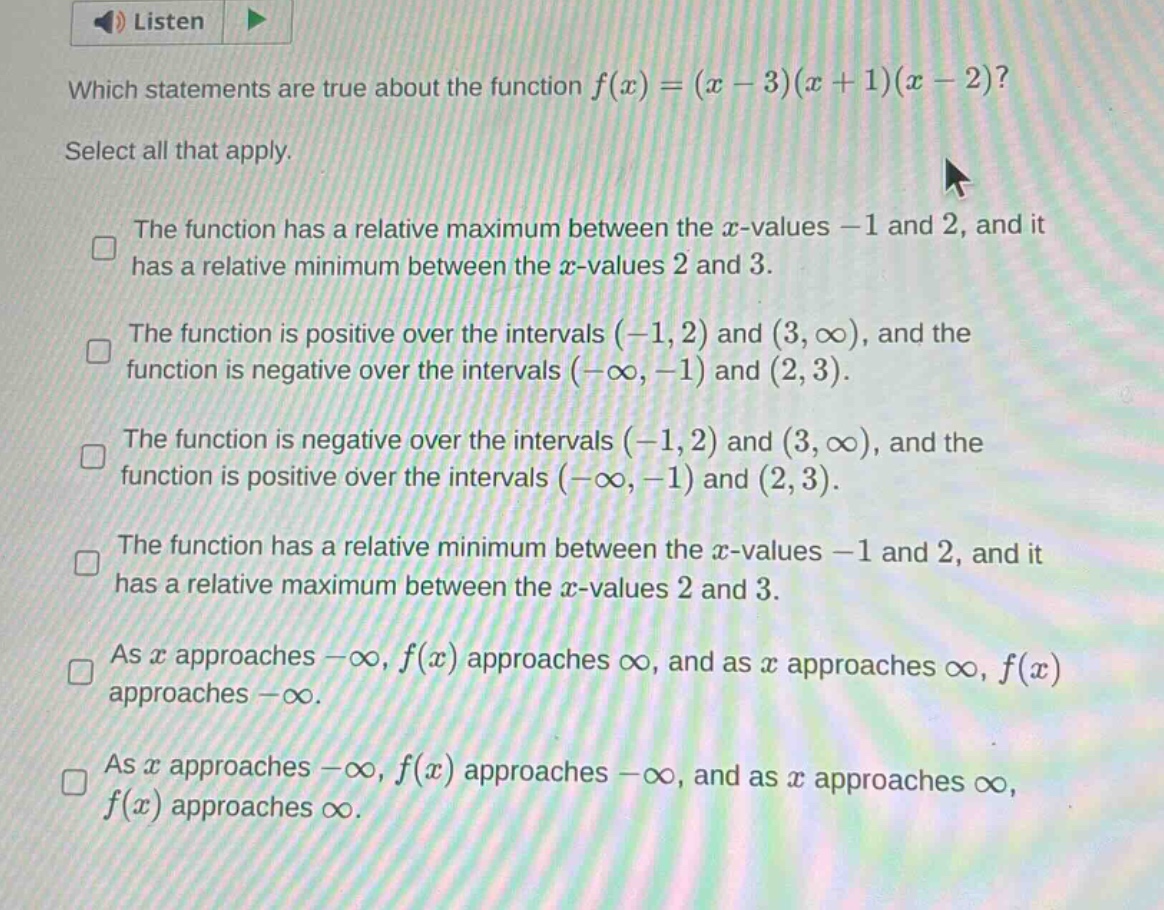
which statements are true about the function f(x)=(x - 3)(x + 1)(x - 2)? select all that apply. the function has a relative maximum between the x - values - 1 and 2, and it has a relative minimum between the x - values 2 and 3. the function is positive over the intervals (-1,2) and (3,∞), and the function is negative over the intervals (-∞,-1) and (2,3). the function is negative over the intervals (-1,2) and (3,∞), and the function is positive over the intervals (-∞,-1) and (2,3). the function has a relative minimum between the x - values - 1 and 2, and it has a relative maximum between the x - values 2 and 3. as x approaches -∞, f(x) approaches ∞, and as x approaches ∞, f(x) approaches -∞. as x approaches -∞, f(x) approaches -∞, and as x approaches ∞, f(x) approaches ∞.
Answer
Explanation:
Step1: Find the roots of the function
The roots of $f(x)=(x - 3)(x + 1)(x - 2)$ are $x=-1,2,3$ since when $x=-1,2,3$, $f(x)=0$.
Step2: Analyze the sign of the function
Choose test - points in the intervals $(-\infty,-1)$, $(-1,2)$, $(2,3)$ and $(3,\infty)$. For $x=-2$, $f(-2)=(-2 - 3)(-2 + 1)(-2 - 2)=(-5)\times(-1)\times(-4)=-20<0$. For $x = 0$, $f(0)=(0 - 3)(0 + 1)(0 - 2)=(-3)\times1\times(-2)=6>0$. For $x=\frac{5}{2}$, $f(\frac{5}{2})=(\frac{5}{2}-3)(\frac{5}{2}+1)(\frac{5}{2}-2)=(-\frac{1}{2})\times(\frac{7}{2})\times(\frac{1}{2})=-\frac{7}{8}<0$. For $x = 4$, $f(4)=(4 - 3)(4 + 1)(4 - 2)=1\times5\times2 = 10>0$. So the function is negative over $(-\infty,-1)$ and $(2,3)$, and positive over $(-1,2)$ and $(3,\infty)$.
Step3: Analyze the end - behavior
The function $f(x)=(x - 3)(x + 1)(x - 2)=x^{3}-4x^{2}+x + 6$ is a cubic function with a positive leading coefficient ($a = 1$ for $y=ax^{3}+bx^{2}+cx + d$). As $x\to-\infty$, $f(x)\to-\infty$ and as $x\to\infty$, $f(x)\to\infty$.
Step4: Analyze relative extrema
By the nature of a cubic function with three distinct real roots, it has a relative maximum between the first two roots and a relative minimum between the last two roots. So it has a relative maximum between $x=-1$ and $x = 2$ and a relative minimum between $x = 2$ and $x=3$.
Answer:
The function has a relative maximum between the $x$-values $-1$ and $2$, and it has a relative minimum between the $x$-values $2$ and $3$. The function is positive over the intervals $(-1,2)$ and $(3,\infty)$, and the function is negative over the intervals $(-\infty,-1)$ and $(2,3)$. As $x$ approaches $-\infty$, $f(x)$ approaches $-\infty$, and as $x$ approaches $\infty$, $f(x)$ approaches $\infty$.