step 5 establish intervals on the x - axis where either an x - intercept or a discontinuity occurs and then…
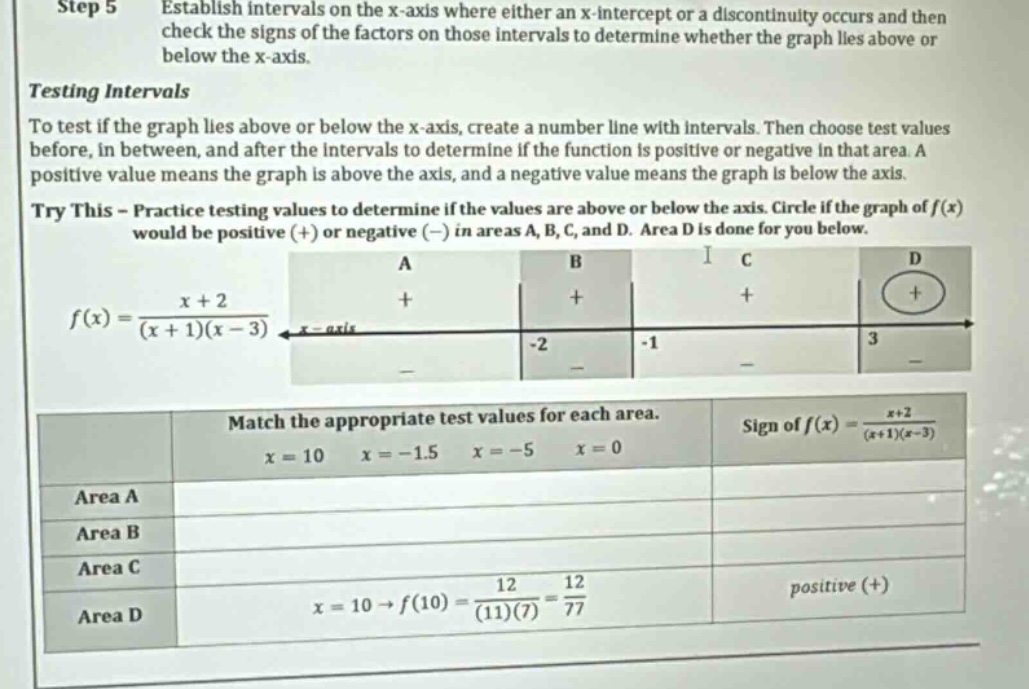
step 5 establish intervals on the x - axis where either an x - intercept or a discontinuity occurs and then check the signs of the factors on those intervals to determine whether the graph lies above or below the x - axis. testing intervals to test if the graph lies above or below the x - axis, create a number line with intervals. then choose test values before, in between, and after the intervals to determine if the function is positive or negative in that area. a positive value means the graph is above the axis, and a negative value means the graph is below the axis. try this - practice testing values to determine if the values are above or below the axis. circle if the graph of f(x) would be positive (+) or negative (-) in areas a, b, c, and d. area d is done for you below. f(x)=(x + 2)/((x + 1)(x - 3)) match the appropriate test values for each area. sign of f(x)=(x + 2)/((x + 1)(x - 3)) x = 10 x=-1.5 x=-5 x = 0 area a area b area c area d x = 10→f(10)=12/((11)(7))=12/77 positive(+)
Answer
Explanation:
Step1: Identify the intervals
The x - intercept is at $x=-2$ and the discontinuities are at $x=-1$ and $x = 3$. The intervals are $(-\infty,-2)$, $(-2,-1)$, $(-1,3)$ and $(3,\infty)$.
Step2: Test values for Area A
Area A is the interval $(-\infty,-2)$. Choose $x=-5$. Then $f(-5)=\frac{-5 + 2}{(-5+1)(-5 - 3)}=\frac{-3}{(-4)(-8)}=-\frac{3}{32}$, so the sign is negative (-).
Step3: Test values for Area B
Area B is the interval $(-2,-1)$. Choose $x=-1.5$. Then $f(-1.5)=\frac{-1.5 + 2}{(-1.5+1)(-1.5 - 3)}=\frac{0.5}{(-0.5)(-4.5)}=\frac{0.5}{2.25}=\frac{2}{9}$, so the sign is positive (+).
Step4: Test values for Area C
Area C is the interval $(-1,3)$. Choose $x = 0$. Then $f(0)=\frac{0 + 2}{(0+1)(0 - 3)}=-\frac{2}{3}$, so the sign is negative (-).
Answer:
| Match the appropriate test values for each area | Sign of $f(x)=\frac{x + 2}{(x + 1)(x-3)}$ | |
|---|---|---|
| Area A | $x=-5$ | negative (-) |
| Area B | $x=-1.5$ | positive (+) |
| Area C | $x = 0$ | negative (-) |
| Area D | $x = 10$ | positive (+) |