step 1 recall that the maclaurin series of a function f(x) is given by the following. f(x)=f(0)+f(0)x+(f(0)/2…
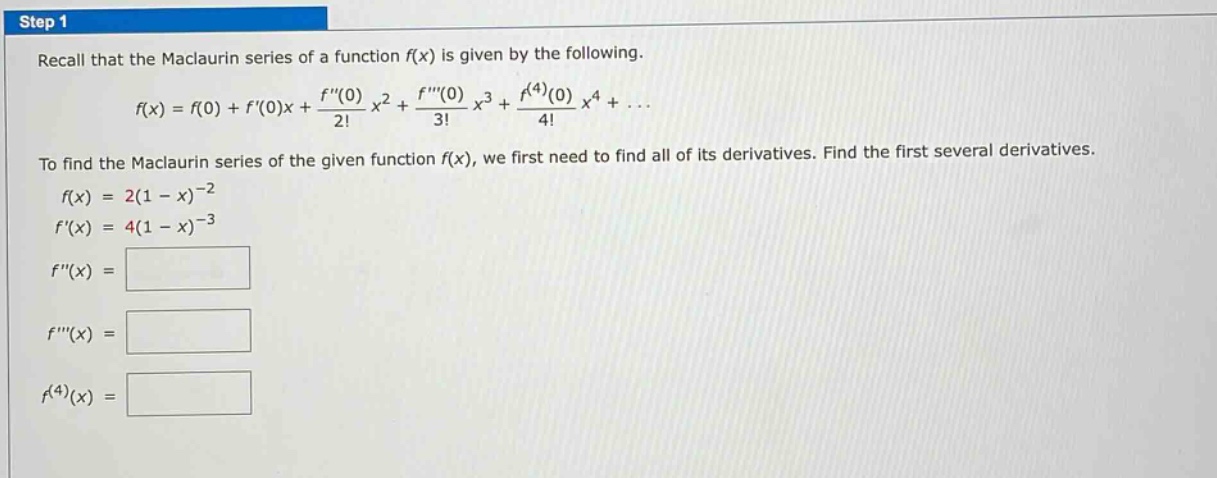
step 1 recall that the maclaurin series of a function f(x) is given by the following. f(x)=f(0)+f(0)x+(f(0)/2!)x²+(f(0)/3!)x³+(f^(4)(0)/4!)x⁴+... to find the maclaurin series of the given function f(x), we first need to find all of its derivatives. find the first several derivatives. f(x)=2(1 - x)^(-2) f(x)=4(1 - x)^(-3) f(x)= f(x)= f^(4)(x)=
Answer
Explanation:
Step1: Differentiate $f'(x)$ to get $f''(x)$
Using the power - rule for differentiation $\frac{d}{dx}(u^n)=nu^{n - 1}u'$. Here $u = 1 - x$ and $n=-3$. Since $u'=-1$, we have $f''(x)=\frac{d}{dx}(4(1 - x)^{-3})=4\times(- 3)(1 - x)^{-4}\times(-1)=12(1 - x)^{-4}$
Step2: Differentiate $f''(x)$ to get $f'''(x)$
Differentiating $f''(x)=12(1 - x)^{-4}$ with the power - rule. We have $f'''(x)=12\times(-4)(1 - x)^{-5}\times(-1)=48(1 - x)^{-5}$
Step3: Differentiate $f'''(x)$ to get $f^{(4)}(x)$
Differentiating $f'''(x)=48(1 - x)^{-5}$ with the power - rule. We have $f^{(4)}(x)=48\times(-5)(1 - x)^{-6}\times(-1)=240(1 - x)^{-6}$
Answer:
$f''(x)=12(1 - x)^{-4}$, $f'''(x)=48(1 - x)^{-5}$, $f^{(4)}(x)=240(1 - x)^{-6}$