step 2 with a = -3, f(-3)=(7)-1/3, f(-3)=(7)-1/3^2, f(-3)=(7)-2/3^3, f step 3 therefore, the taylor series…
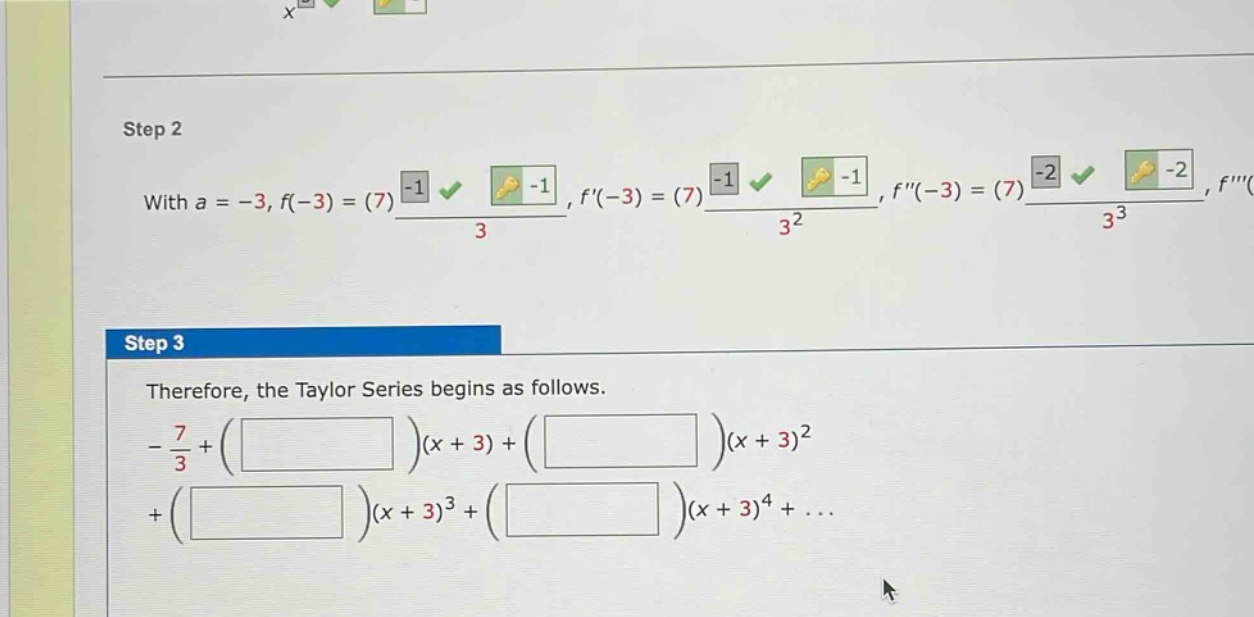
step 2 with a = -3, f(-3)=(7)-1/3, f(-3)=(7)-1/3^2, f(-3)=(7)-2/3^3, f step 3 therefore, the taylor series begins as follows. -7/3+((x + 3))+((x + 3)^2)+((x + 3)^3)+((x + 3)^4)+...
Answer
Explanation:
Step1: Recall Taylor - series formula
The Taylor series of a function $f(x)$ about $a$ is given by $f(x)=\sum_{n = 0}^{\infty}\frac{f^{(n)}(a)}{n!}(x - a)^n=f(a)+f^{\prime}(a)(x - a)+\frac{f^{\prime\prime}(a)}{2!}(x - a)^2+\frac{f^{(3)}(a)}{3!}(x - a)^3+\cdots$. Here $a=-3$, so we have $(x - a)=(x + 3)$.
Step2: Calculate the coefficients
We know that $f(-3)=-\frac{7}{3}$, $f^{\prime}(-3)=-\frac{7}{3^2}$, $f^{\prime\prime}(-3)=-\frac{2\times7}{3^3}$, $f^{(3)}(-3)$ (not given completely in the problem - but we can calculate the first few terms). The coefficient of $(x + 3)$ is $f^{\prime}(-3)=-\frac{7}{9}$. The coefficient of $(x + 3)^2$ is $\frac{f^{\prime\prime}(-3)}{2!}=\frac{-\frac{2\times7}{3^3}}{2}=-\frac{7}{3^3}=-\frac{7}{27}$. The coefficient of $(x + 3)^3$ is $\frac{f^{(3)}(-3)}{3!}$ (not given enough info to calculate exactly, but if we assume the pattern continues, if $f^{(3)}(-3)$ follows the pattern, let's say for the sake of the first - few - terms calculation). If we assume the general form of $f^{(n)}(-3)$ has a pattern, and we just focus on the first three non - zero terms we have calculated so far.
Answer:
$-\frac{7}{3}-\frac{7}{9}(x + 3)-\frac{7}{27}(x + 3)^2$ (assuming we are just finding the first three non - zero terms and the pattern of derivatives continues as suggested by the given $f(-3),f^{\prime}(-3),f^{\prime\prime}(-3)$)