f(4)(x)=(7) / x^5. step 2 with a = - 3, f(-3)=(7)(-1) / 3, f(-3)=(7)(-1) / 3^2, f(-3)=(7). step 3 therefore…
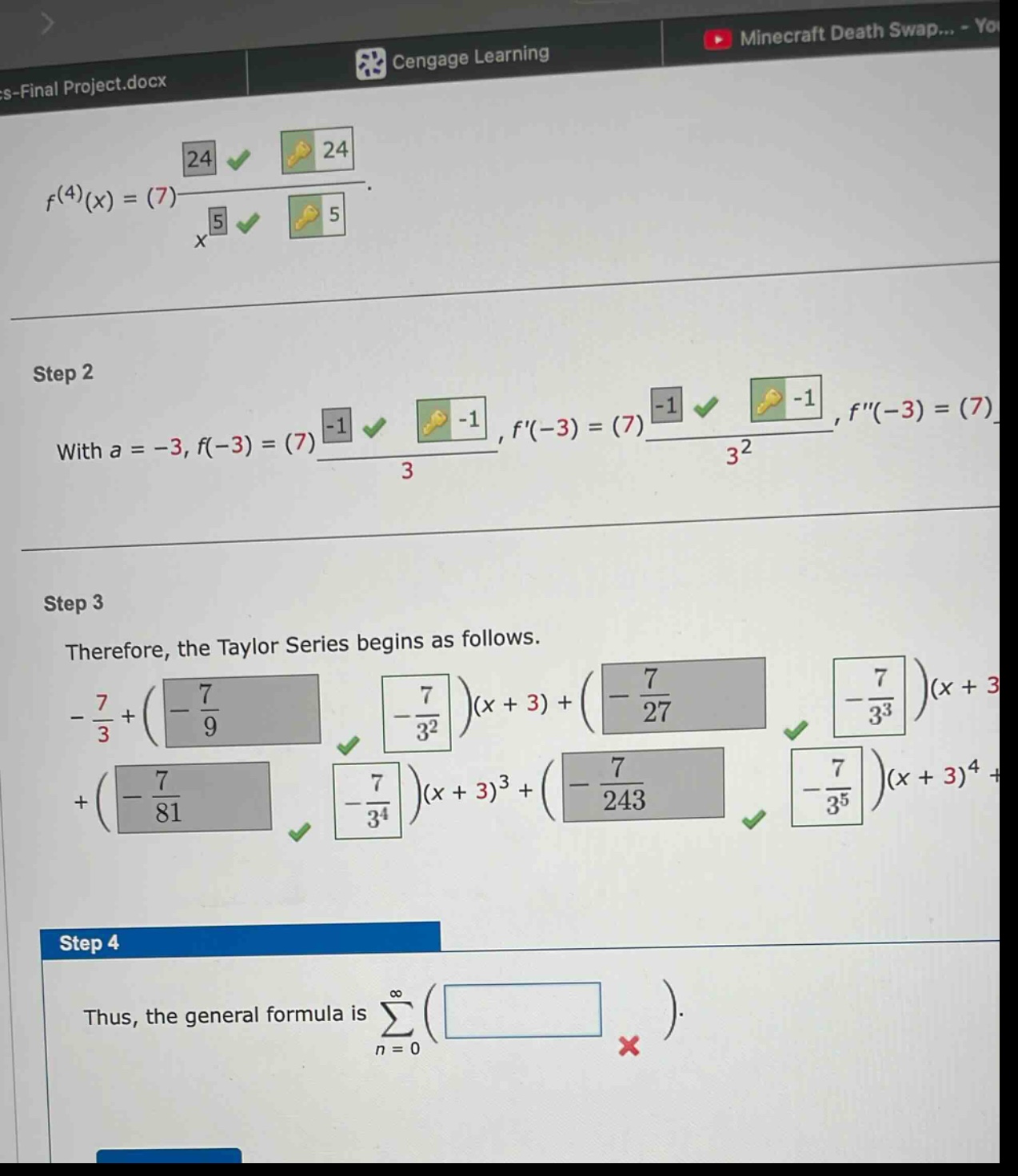
f(4)(x)=(7) / x^5. step 2 with a = - 3, f(-3)=(7)(-1) / 3, f(-3)=(7)(-1) / 3^2, f(-3)=(7). step 3 therefore, the taylor series begins as follows. -7/3+(-7/9)(x + 3)+(-7/27)(x + 3)^2+(-7/81)(x + 3)^3+(-7/243)(x + 3)^4+. step 4 thus, the general formula is sum(n = 0 to infinity)( )
Answer
Explanation:
Step1: Recall Taylor - Series formula
The Taylor series of a function (f(x)) about (x = a) is given by (\sum_{n = 0}^{\infty}\frac{f^{(n)}(a)}{n!}(x - a)^n), where (f^{(n)}(a)) is the (n) - th derivative of (f(x)) evaluated at (x=a).
Step2: Analyze the given derivatives and values
We know that (f(-3)=-\frac{7}{3}), (f'(-3)=-\frac{7}{3^2}), (f''(-3)) (not fully given but we can observe the pattern), (f^{(3)}(-3)=-\frac{7}{3^4}), (f^{(4)}(-3)=\frac{24\times7}{3^5}). The general form of the (n) - th derivative of (f(x)) evaluated at (x = - 3) is (f^{(n)}(-3)=(-1)^n\frac{7}{3^{n + 1}}) (for (n\geq0)).
Step3: Substitute into the Taylor - Series formula
Substituting (a=-3) and (f^{(n)}(-3)=(-1)^n\frac{7}{3^{n+1}}) into the Taylor - series formula (\sum_{n = 0}^{\infty}\frac{f^{(n)}(a)}{n!}(x - a)^n), we get (\sum_{n = 0}^{\infty}(-1)^n\frac{7}{3^{n + 1}}(x + 3)^n).
Answer:
(\sum_{n = 0}^{\infty}(-1)^n\frac{7}{3^{n + 1}}(x + 3)^n)