step 1 the taylor polynomial with degree n = 3 is t_3(x)=f(a)+f(a)(x - a)+(f(a))/(2!)(x - a)^2+(f(a))/(3!)(x…
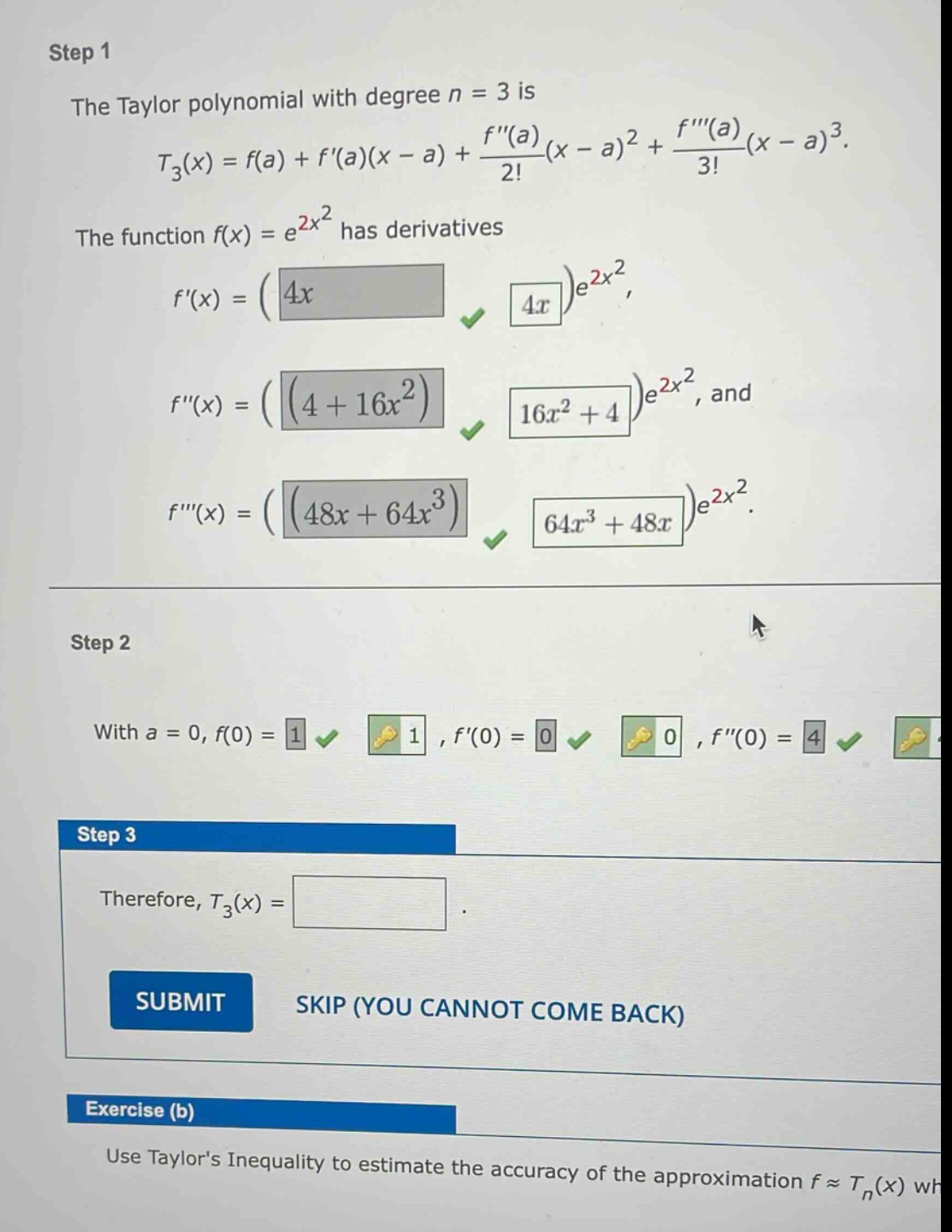
step 1 the taylor polynomial with degree n = 3 is t_3(x)=f(a)+f(a)(x - a)+(f(a))/(2!)(x - a)^2+(f(a))/(3!)(x - a)^3. the function f(x)=e^(2x^2) has derivatives f(x)=(4x)e^(2x^2), f(x)=((4 + 16x^2))e^(2x^2), and f(x)=((48x + 64x^3))e^(2x^2). step 2 with a = 0, f(0)=1, f(0)=0, f(0)=4. step 3 therefore, t_3(x)=. submit skip (you cannot come back) exercise (b) use taylors inequality to estimate the accuracy of the approximation f≈t_n(x) wh
Answer
Explanation:
Step1: Recall Taylor - polynomial formula
The Taylor polynomial of degree $n = 3$ is $T_3(x)=f(a)+f^{\prime}(a)(x - a)+\frac{f^{\prime\prime}(a)}{2!}(x - a)^2+\frac{f^{\prime\prime\prime}(a)}{3!}(x - a)^3$.
Step2: Substitute $a = 0$ values
We know that $f(0)=1$, $f^{\prime}(0)=0$, $f^{\prime\prime}(0)=4$, $f^{\prime\prime\prime}(0)=0$ (since when we substitute $x = 0$ into $f^{\prime\prime\prime}(x)=(48x + 64x^3)e^{2x^2}$, we get $0$).
Step3: Calculate $T_3(x)$
Substitute the values into the Taylor - polynomial formula: [ \begin{align*} T_3(x)&=f(0)+f^{\prime}(0)(x - 0)+\frac{f^{\prime\prime}(0)}{2!}(x - 0)^2+\frac{f^{\prime\prime\prime}(0)}{3!}(x - 0)^3\ &=1+0\times x+\frac{4}{2}x^2+0\times x^3\ &=1 + 2x^2 \end{align*} ]
Answer:
$1 + 2x^2$