step 2\nwe have found the following maclaurin series.\ncos(1/15 x^2) = sum(n = 0 to infinity) (-1)^n…
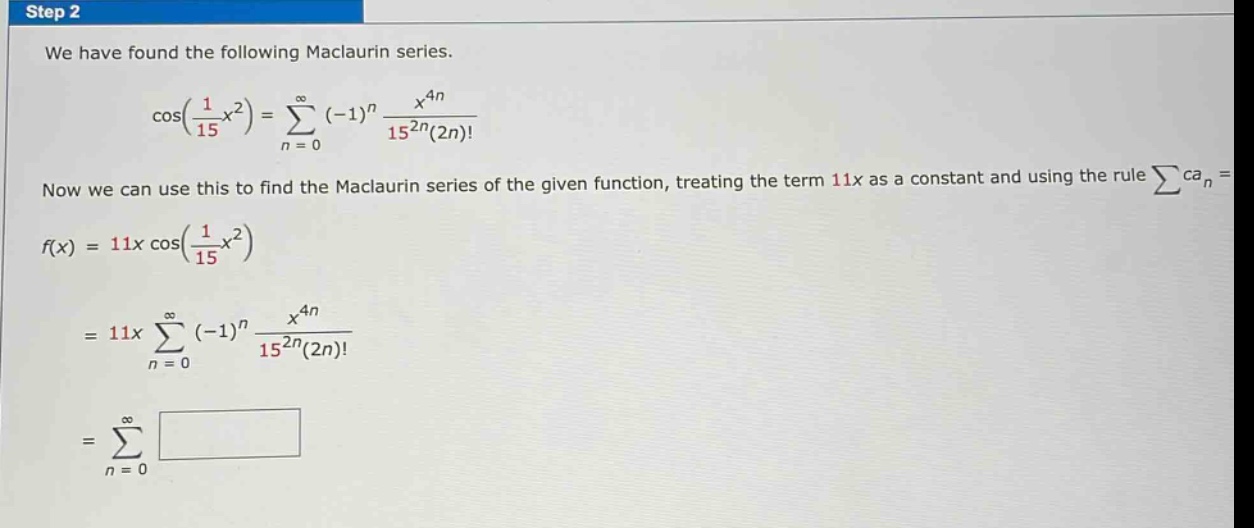
step 2\nwe have found the following maclaurin series.\ncos(1/15 x^2) = sum(n = 0 to infinity) (-1)^n x^(4n)/15^(2n)(2n)!\nnow we can use this to find the maclaurin series of the given function, treating the term 11x as a constant and using the rule sum(ca_n)\nf(x) = 11x cos(1/15 x^2)\n= 11x sum(n = 0 to infinity) (-1)^n x^(4n)/15^(2n)(2n)!\n= sum(n = 0 to infinity)
Answer
Explanation:
Step1: Multiply 11x into the series
We multiply 11x by each term of the series $\sum_{n = 0}^{\infty}(-1)^{n}\frac{x^{4n}}{15^{2n}(2n)!}$. Since $11x\cdot x^{4n}=11x^{4n + 1}$, the series becomes $\sum_{n = 0}^{\infty}(-1)^{n}\frac{11x^{4n+1}}{15^{2n}(2n)!}$.
Answer:
$\sum_{n = 0}^{\infty}(-1)^{n}\frac{11x^{4n + 1}}{15^{2n}(2n)!}$