a student graphs the functions f(x) and g(x). the student claims that f(-3)=g(-3) and f(1)=g(1). is the…
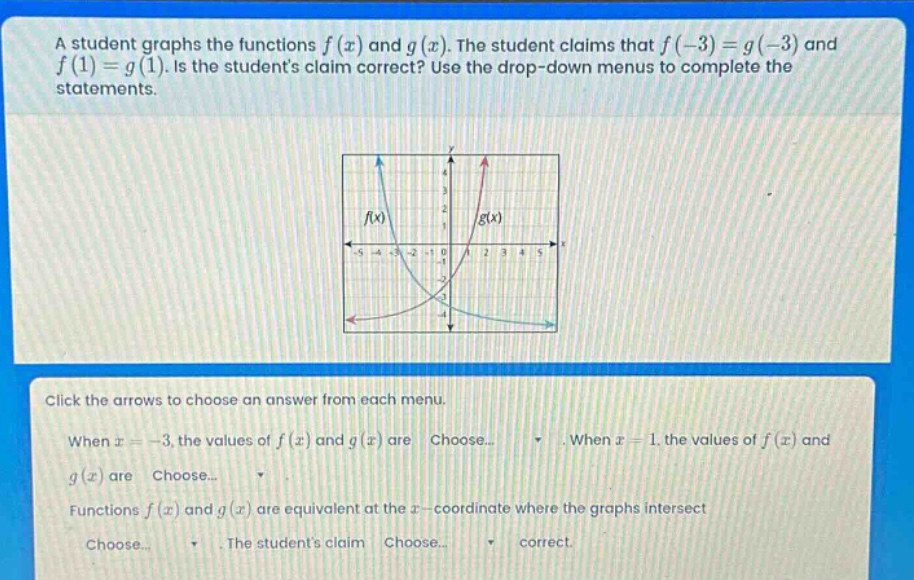
a student graphs the functions f(x) and g(x). the student claims that f(-3)=g(-3) and f(1)=g(1). is the students claim correct? use the drop - down menus to complete the statements. click the arrows to choose an answer from each menu. when x = - 3, the values of f(x) and g(x) are choose... when x = 1, the values of f(x) and g(x) are choose... functions f(x) and g(x) are equivalent at the x - coordinate where the graphs intersect choose... the students claim choose... correct.
Answer
Explanation:
Step1: Evaluate at $x = - 3$
Locate $x=-3$ on the x - axis. Observe the y - values of $f(x)$ and $g(x)$. The y - value of $f(-3)$ is not equal to the y - value of $g(-3)$.
Step2: Evaluate at $x = 1$
Locate $x = 1$ on the x - axis. Observe the y - values of $f(x)$ and $g(x)$. The y - value of $f(1)$ is not equal to the y - value of $g(1)$.
Step3: Recall intersection property
Functions $f(x)$ and $g(x)$ are equivalent at the x - coordinates where their graphs intersect. The graphs of $f(x)$ and $g(x)$ intersect at a different x - value.
Answer:
When $x=-3$, the values of $f(x)$ and $g(x)$ are not equal. When $x = 1$, the values of $f(x)$ and $g(x)$ are not equal. Functions $f(x)$ and $g(x)$ are equivalent at the x - coordinate where the graphs intersect at a different x - value. The student's claim is not correct.