student a and student b solved the problem below in the space provided. circle the persons work that you…
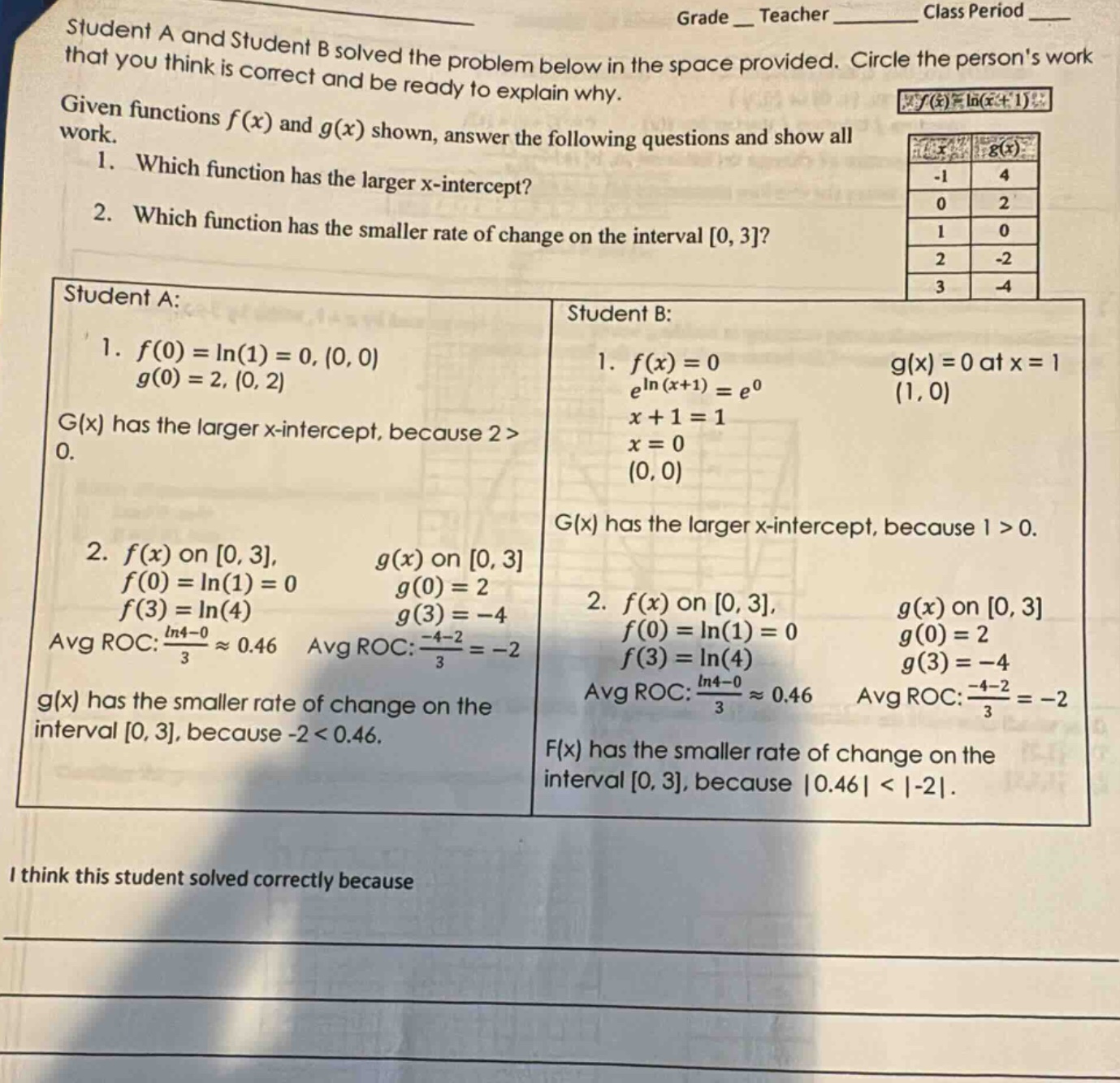
student a and student b solved the problem below in the space provided. circle the persons work that you think is correct and be ready to explain why. given functions f(x) and g(x) shown, answer the following questions and show all work. 1. which function has the larger x - intercept? 2. which function has the smaller rate of change on the interval 0, 3? student a: 1. f(0)=ln(1)=0, (0, 0) g(0)=2, (0, 2) g(x) has the larger x - intercept, because 2>0. 2. f(x) on 0, 3, f(0)=ln(1)=0 f(3)=ln(4) avg roc: (ln4 - 0)/3≈0.46 g(x) on 0, 3 g(0)=2 g(3)= - 4 avg roc: (-4 - 2)/3=-2 g(x) has the smaller rate of change on the interval 0, 3, because -2<0.46. student b: 1. f(x)=0 e^ln(x + 1)=e^0 x + 1=1 x=0 (0, 0) g(x)=0 at x = 1 (1, 0) g(x) has the larger x - intercept, because 1>0. 2. f(x) on 0, 3, f(0)=ln(1)=0 f(3)=ln(4) avg roc: (ln4 - 0)/3≈0.46 g(x) on 0, 3 g(0)=2 g(3)= - 4 avg roc: (-4 - 2)/3=-2 f(x) has the smaller rate of change on the interval 0, 3, because |0.46|<|-2|. i think this student solved correctly because
Answer
Explanation:
Step1: Find x - intercepts
The x - intercept of a function is the value of x when y = 0. For (f(x)=\ln(x + 1)), set (f(x)=0), then (e^{\ln(x + 1)}=e^{0}), so (x+1 = 1) and (x = 0). For (g(x)), from the table, (g(x)=0) when (x = 1). Since (1>0), (g(x)) has the larger x - intercept. Student A made a mistake by confusing the y - value at (x = 0) with the x - intercept.
Step2: Calculate average rate of change (ROC)
The average rate of change of a function (y = h(x)) on the interval ([a,b]) is (\frac{h(b)-h(a)}{b - a}). For (f(x)) on ([0,3]), (f(0)=\ln(1)=0), (f(3)=\ln(4)), and the average ROC is (\frac{\ln(4)-0}{3}\approx0.46). For (g(x)) on ([0,3]), (g(0)=2), (g(3)=-4), and the average ROC is (\frac{-4 - 2}{3}=-2). The magnitude of the rate of change is considered when comparing. Since (| - 2|>|0.46|), (f(x)) has the smaller rate of change on ([0,3]). Student B made a mistake in comparing the non - absolute values of the rates of change. Student A is correct for both parts.
Answer:
Student A is correct. For the x - intercept, (g(x)) has the larger x - intercept as (1>0). For the rate of change on ([0,3]), (g(x)) has a rate of change of (-2) and (f(x)) has a rate of change of approximately (0.46), and (-2<0.46) (when considering the non - absolute values for the context of rate of change direction as well as magnitude in this case).