on which subintervals of 0<x<π is 3sin(2x)-5<-4?
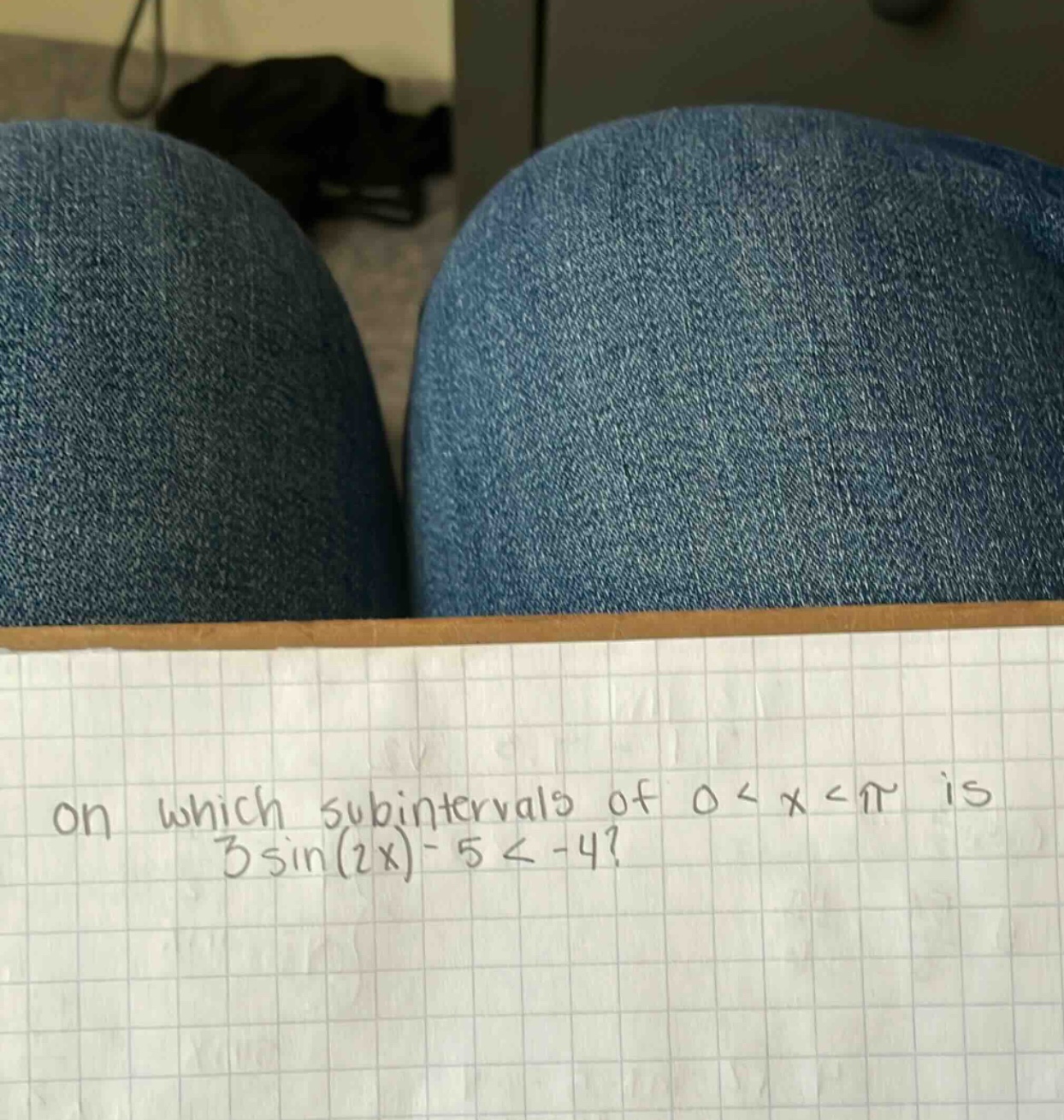
on which subintervals of 0<x<π is 3sin(2x)-5<-4?
Answer
Explanation:
Step1: Rearrange the inequality
Add 5 to both sides of $3\sin(2x)-5 < - 4$. We get $3\sin(2x)<1$, then $\sin(2x)<\frac{1}{3}$.
Step2: Let $t = 2x$.
The range of $x$ is $0 < x<\pi$, so the range of $t$ is $0 < t<2\pi$. We need to solve $\sin(t)<\frac{1}{3}$ for $t\in(0,2\pi)$. We know that $\sin^{-1}(\frac{1}{3})\approx0.34$ (in radians). The sine - function is symmetric about $t=\frac{\pi}{2}$ and $t = \frac{3\pi}{2}$. The solutions of $\sin(t)=\frac{1}{3}$ in the interval $(0,2\pi)$ are $t_1=\sin^{-1}(\frac{1}{3})$ and $t_2=\pi-\sin^{-1}(\frac{1}{3})$. So the solution of $\sin(t)<\frac{1}{3}$ for $t\in(0,2\pi)$ is $0 < t<\sin^{-1}(\frac{1}{3})\cup(\pi - \sin^{-1}(\frac{1}{3}),2\pi)$.
Step3: Substitute back $t = 2x$.
Since $t = 2x$, we have $0 < 2x<\sin^{-1}(\frac{1}{3})\cup(\pi-\sin^{-1}(\frac{1}{3}),2\pi)$. Dividing each part of the compound - inequality by 2, we get $0 < x<\frac{1}{2}\sin^{-1}(\frac{1}{3})\cup(\frac{\pi}{2}-\frac{1}{2}\sin^{-1}(\frac{1}{3}),\pi)$.
Answer:
$0 < x<\frac{1}{2}\sin^{-1}(\frac{1}{3})\cup(\frac{\pi}{2}-\frac{1}{2}\sin^{-1}(\frac{1}{3}),\pi)$