1.) $sum_{n = 1}^{infty}\frac{n^{2}}{n^{2}+n}$\n2.) $sum_{n = 1}^{infty}\frac{n}{sqrt{n + 3}}$\n3.) $sum_{n…
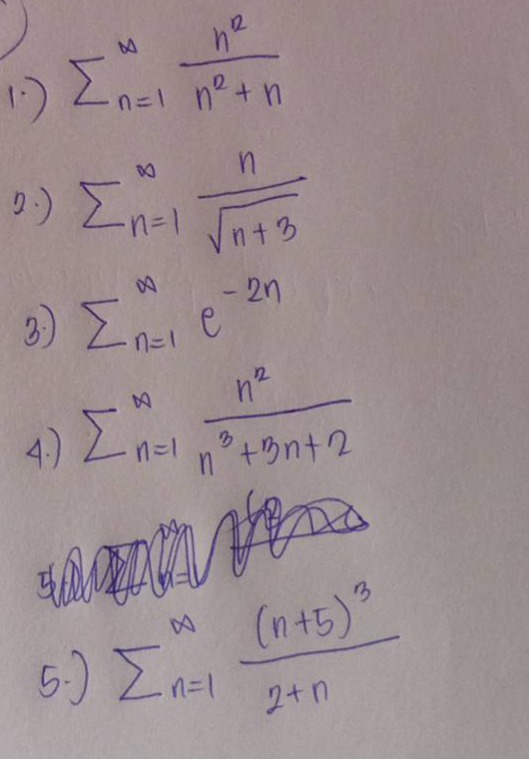
1.) $sum_{n = 1}^{infty}\frac{n^{2}}{n^{2}+n}$\n2.) $sum_{n = 1}^{infty}\frac{n}{sqrt{n + 3}}$\n3.) $sum_{n = 1}^{infty}e^{-2n}$\n4.) $sum_{n = 1}^{infty}\frac{n^{2}}{n^{3}+3n + 2}$\n5.) $sum_{n = 1}^{infty}\frac{(n + 5)^{3}}{2 + n}$
Answer
Explanation:
Step1: Analyze the first series
For $\sum_{n = 1}^{\infty}\frac{n^{2}}{n^{2}+n}$, simplify the general - term $a_{n}=\frac{n^{2}}{n^{2}+n}=\frac{n^{2}}{n(n + 1)}=\frac{n}{n + 1}=1-\frac{1}{n + 1}$. $\lim_{n\rightarrow\infty}a_{n}=\lim_{n\rightarrow\infty}(1-\frac{1}{n + 1}) = 1\neq0$. By the $n$ - th term test for divergence, if $\lim_{n\rightarrow\infty}a_{n}\neq0$, then $\sum_{n = 1}^{\infty}a_{n}$ diverges.
Step2: Analyze the second series
For $\sum_{n = 1}^{\infty}\frac{n}{\sqrt{n + 3}}$, use the limit - comparison test. Compare with the series $\sum_{n = 1}^{\infty}\sqrt{n}$. $\lim_{n\rightarrow\infty}\frac{\frac{n}{\sqrt{n + 3}}}{\sqrt{n}}=\lim_{n\rightarrow\infty}\frac{n}{\sqrt{n(n + 3)}}=\lim_{n\rightarrow\infty}\frac{n}{\sqrt{n^{2}+3n}}=\lim_{n\rightarrow\infty}\frac{1}{\sqrt{1+\frac{3}{n}}}=1$. Since $\sum_{n = 1}^{\infty}\sqrt{n}=\sum_{n = 1}^{\infty}n^{\frac{1}{2}}$ and $p=\frac{1}{2}<1$, $\sum_{n = 1}^{\infty}\sqrt{n}$ diverges. So, by the limit - comparison test, $\sum_{n = 1}^{\infty}\frac{n}{\sqrt{n + 3}}$ diverges.
Step3: Analyze the third series
For $\sum_{n = 1}^{\infty}e^{-2n}=\sum_{n = 1}^{\infty}(e^{-2})^{n}$, this is a geometric series with common ratio $r = e^{-2}=\frac{1}{e^{2}}$. Since $|r|=\frac{1}{e^{2}}<1$, by the geometric - series test, a geometric series $\sum_{n = 1}^{\infty}ar^{n - 1}$ (in our case $a = e^{-2}$ and $r=e^{-2}$) converges.
Step4: Analyze the fourth series
For $\sum_{n = 1}^{\infty}\frac{n^{2}}{n^{3}+3n + 2}$, use the limit - comparison test. Compare with the series $\sum_{n = 1}^{\infty}\frac{1}{n}$. $\lim_{n\rightarrow\infty}\frac{\frac{n^{2}}{n^{3}+3n + 2}}{\frac{1}{n}}=\lim_{n\rightarrow\infty}\frac{n^{3}}{n^{3}+3n + 2}=\lim_{n\rightarrow\infty}\frac{1}{1+\frac{3}{n^{2}}+\frac{2}{n^{3}}}=1$. Since $\sum_{n = 1}^{\infty}\frac{1}{n}$ is a harmonic series ($p = 1$) and diverges, by the limit - comparison test, $\sum_{n = 1}^{\infty}\frac{n^{2}}{n^{3}+3n + 2}$ diverges.
Step5: Analyze the fifth series
For $\sum_{n = 1}^{\infty}\frac{(n + 5)^{3}}{2 + n}$, expand $(n + 5)^{3}=n^{3}+15n^{2}+75n + 125$. Then $\frac{(n + 5)^{3}}{2 + n}=\frac{n^{3}+15n^{2}+75n + 125}{n + 2}$. Using polynomial long - division or by considering the highest - degree terms, $\lim_{n\rightarrow\infty}\frac{(n + 5)^{3}}{2 + n}=\infty$. By the $n$ - th term test for divergence, since $\lim_{n\rightarrow\infty}a_{n}\neq0$, $\sum_{n = 1}^{\infty}\frac{(n + 5)^{3}}{2 + n}$ diverges.
Answer:
- Diverges
- Diverges
- Converges
- Diverges
- Diverges