summarize the pertinent information obtained by applying the graphing strategy and sketch the graph of…
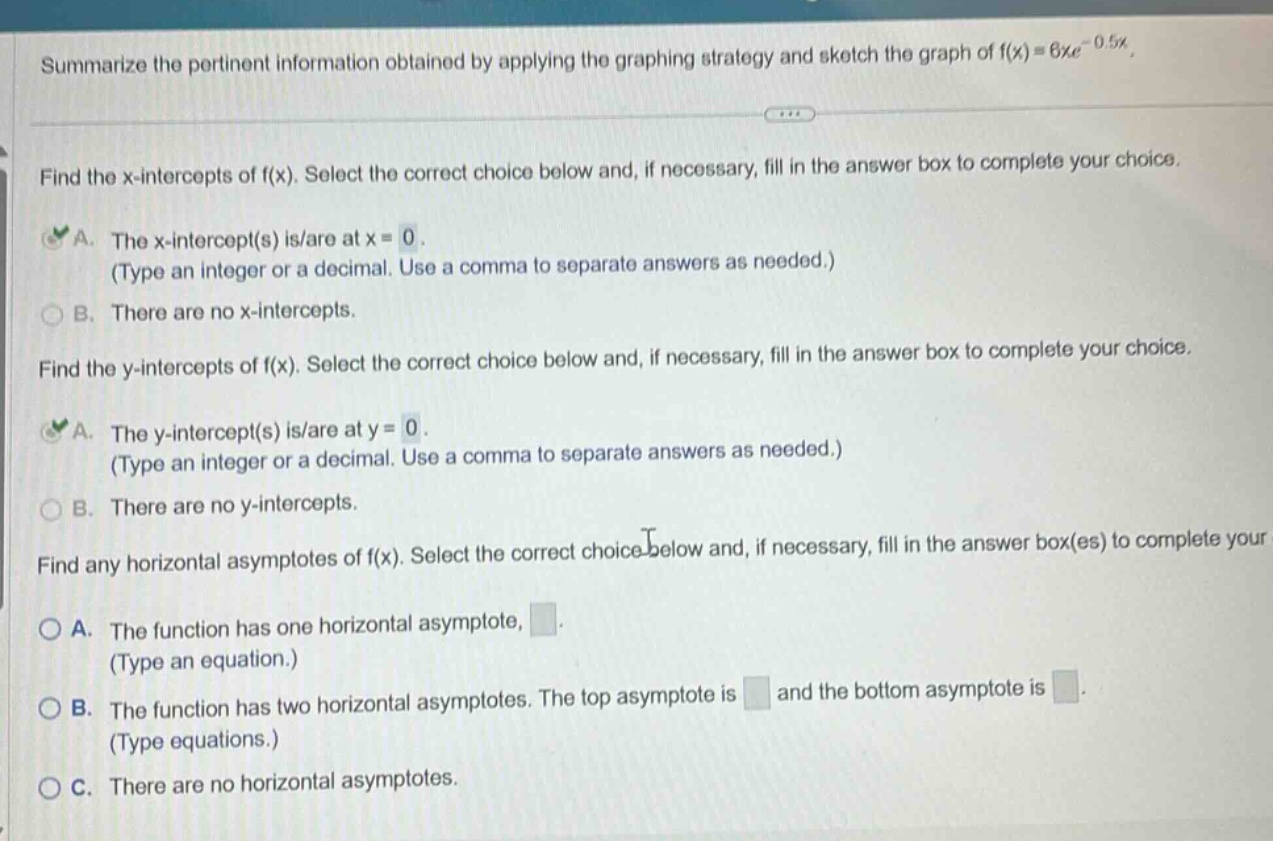
summarize the pertinent information obtained by applying the graphing strategy and sketch the graph of f(x)=6xe^(-0.5x). find the x - intercepts of f(x). select the correct choice below and, if necessary, fill in the answer box to complete your choice. a. the x - intercept(s) is/are at x = 0. (type an integer or a decimal. use a comma to separate answers as needed.) b. there are no x - intercepts. find the y - intercepts of f(x). select the correct choice below and, if necessary, fill in the answer box to complete your choice. a. the y - intercept(s) is/are at y = 0. (type an integer or a decimal. use a comma to separate answers as needed.) b. there are no y - intercepts. find any horizontal asymptotes of f(x). select the correct choice below and, if necessary, fill in the answer box(es) to complete your choice. a. the function has one horizontal asymptote, . (type an equation.) b. the function has two horizontal asymptotes. the top asymptote is and the bottom asymptote is . (type equations.) c. there are no horizontal asymptotes.
Answer
Explanation:
Step1: Recall horizontal - asymptote formula
To find the horizontal asymptote of (y = f(x)=6xe^{-0.5x}=\frac{6x}{e^{0.5x}}), we use the limit as (x\to\pm\infty).
Step2: Calculate (\lim_{x\to+\infty}\frac{6x}{e^{0.5x}})
Apply L'Hopital's rule. Since (\lim_{x\to+\infty}6x=\infty) and (\lim_{x\to+\infty}e^{0.5x}=\infty), by L'Hopital's rule (\lim_{x\to+\infty}\frac{6x}{e^{0.5x}}=\lim_{x\to+\infty}\frac{6}{0.5e^{0.5x}}).
Step3: Evaluate the limit
As (x\to+\infty), (\lim_{x\to+\infty}\frac{6}{0.5e^{0.5x}} = 0).
Step4: Calculate (\lim_{x\to-\infty}\frac{6x}{e^{0.5x}})
As (x\to-\infty), (e^{0.5x}=\frac{1}{e^{- 0.5x}}\to0) and (6x\to-\infty), so (\lim_{x\to-\infty}\frac{6x}{e^{0.5x}}=-\infty).
Answer:
A. The function has one horizontal asymptote, (y = 0).