summarize the pertinent information obtained by applying the graphing strategy and sketch the graph of…
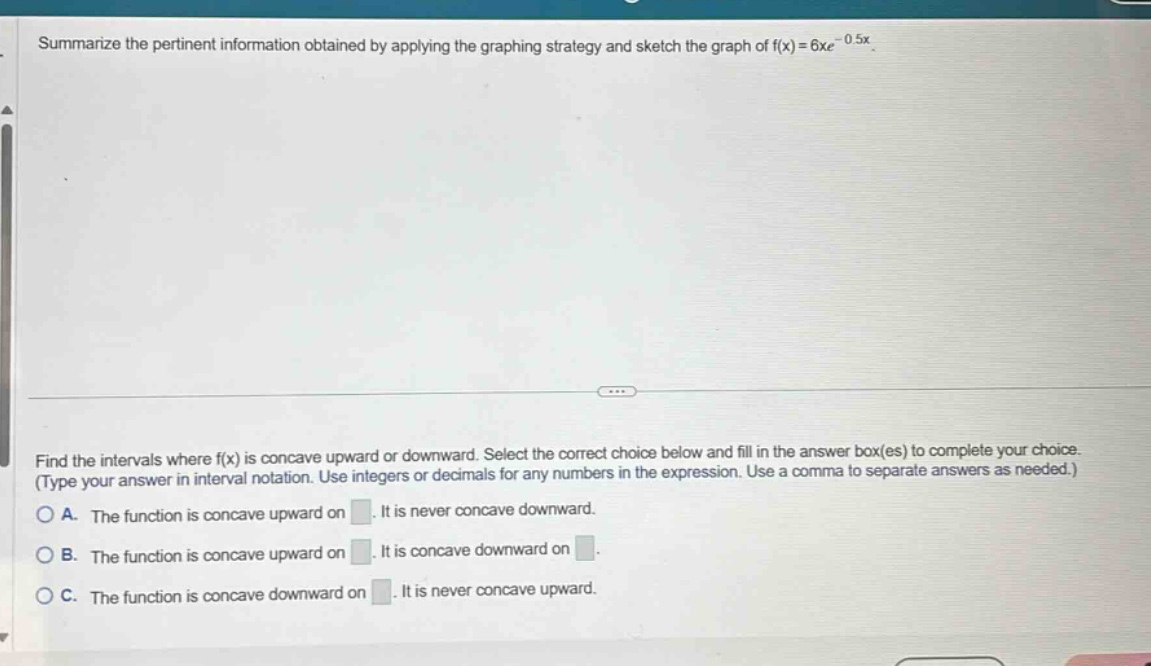
summarize the pertinent information obtained by applying the graphing strategy and sketch the graph of f(x)=6xe^(-0.5x). find the intervals where f(x) is concave upward or downward. select the correct choice below and fill in the answer box(es) to complete your choice. (type your answer in interval notation. use integers or decimals for any numbers in the expression. use a comma to separate answers as needed.) a. the function is concave upward on . it is never concave downward. b. the function is concave upward on . it is concave downward on . c. the function is concave downward on . it is never concave upward.
Answer
Explanation:
Step1: Find the first - derivative
Use the product rule $(uv)^\prime = u^\prime v+uv^\prime$, where $u = 6x$ and $v=e^{- 0.5x}$. $u^\prime=6$ and $v^\prime=-0.5e^{-0.5x}$. So $f^\prime(x)=6e^{-0.5x}+6x(-0.5e^{-0.5x})=6e^{-0.5x}(1 - 0.5x)$.
Step2: Find the second - derivative
Use the product rule again on $f^\prime(x)=6e^{-0.5x}(1 - 0.5x)$. Let $u = 6(1 - 0.5x)$ and $v = e^{-0.5x}$. $u^\prime=-3$ and $v^\prime=-0.5e^{-0.5x}$. $f^{\prime\prime}(x)=-3e^{-0.5x}+6(1 - 0.5x)(-0.5e^{-0.5x})=e^{-0.5x}(-3 - 3 + 1.5x)=e^{-0.5x}(1.5x - 6)$.
Step3: Find the inflection points
Set $f^{\prime\prime}(x)=0$. Since $e^{-0.5x}\gt0$ for all real $x$, we solve $1.5x - 6 = 0$. $1.5x=6$, so $x = 4$.
Step4: Determine concavity
Test intervals. Consider the intervals $(-\infty,4)$ and $(4,\infty)$. For $x\lt4$, say $x = 0$, then $f^{\prime\prime}(0)=e^{0}(0 - 6)=-6\lt0$. So $f(x)$ is concave downward on $(-\infty,4)$. For $x\gt4$, say $x = 5$, then $f^{\prime\prime}(5)=e^{-2.5}(7.5 - 6)=1.5e^{-2.5}\gt0$. So $f(x)$ is concave upward on $(4,\infty)$.
Answer:
B. The function is concave upward on $(4,\infty)$. It is concave downward on $(-\infty,4)$.