summarize the pertinent information obtained by applying the graphing strategy and sketch the graph of…
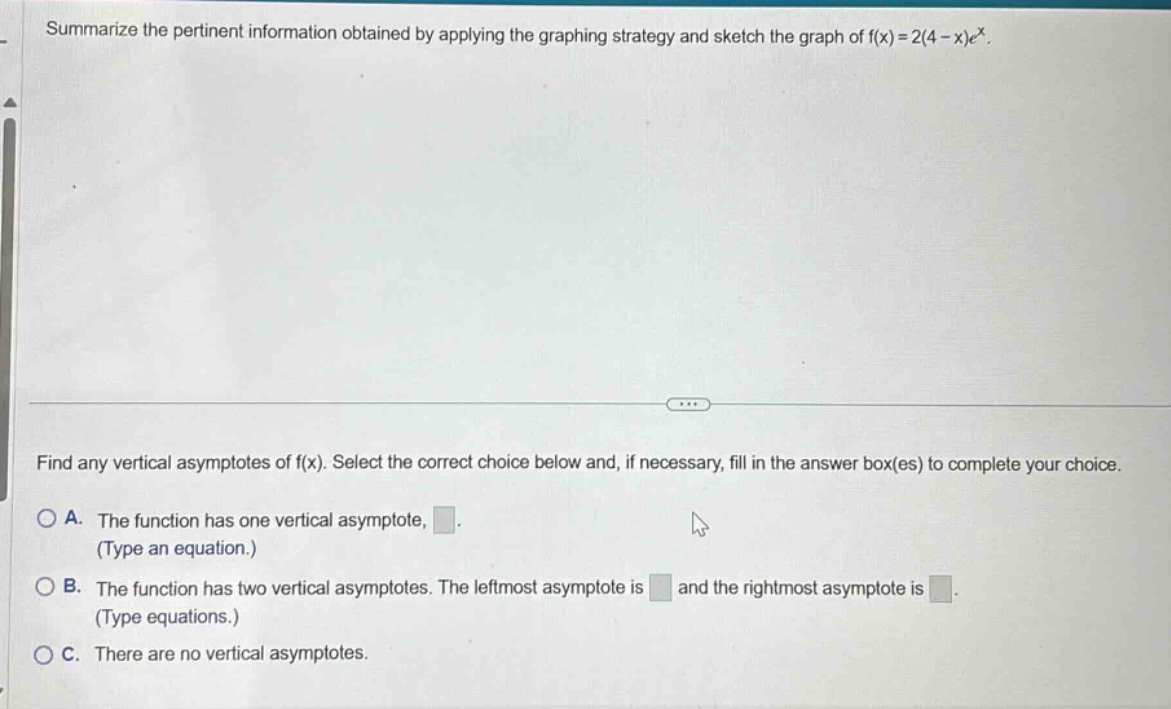
summarize the pertinent information obtained by applying the graphing strategy and sketch the graph of f(x)=2(4 - x)e^x. find any vertical asymptotes of f(x). select the correct choice below and, if necessary, fill in the answer box(es) to complete your choice. a. the function has one vertical asymptote, (type an equation.) b. the function has two vertical asymptotes. the leftmost asymptote is and the rightmost asymptote is (type equations.) c. there are no vertical asymptotes.
Answer
Explanation:
Step1: Recall vertical - asymptote definition
Vertical asymptotes occur where the function is undefined and the limit approaches infinity or negative infinity. For a function of the form $y = f(x)=\frac{g(x)}{h(x)}$, vertical asymptotes are at the values of $x$ that make $h(x)=0$. The given function is $f(x)=2(4 - x)e^{x}=\frac{2(4 - x)}{e^{-x}}$. The exponential function $y = e^{-x}=\frac{1}{e^{x}}$ is defined for all real - valued $x$, i.e., $e^{-x}\neq0$ for all $x\in(-\infty,\infty)$. Also, $2(4 - x)$ is a polynomial and is defined for all real $x$.
Step2: Determine the existence of vertical asymptotes
Since both the numerator $2(4 - x)$ (a polynomial) and the denominator $e^{-x}$ (an exponential function) are defined for all real $x$, the function $f(x)=2(4 - x)e^{x}$ has no values of $x$ for which it is undefined in the real - number system. So, there are no vertical asymptotes.
Answer:
C. There are no vertical asymptotes.