summarize the pertinent information obtained by applying the graphing strategy and sketch the graph of…
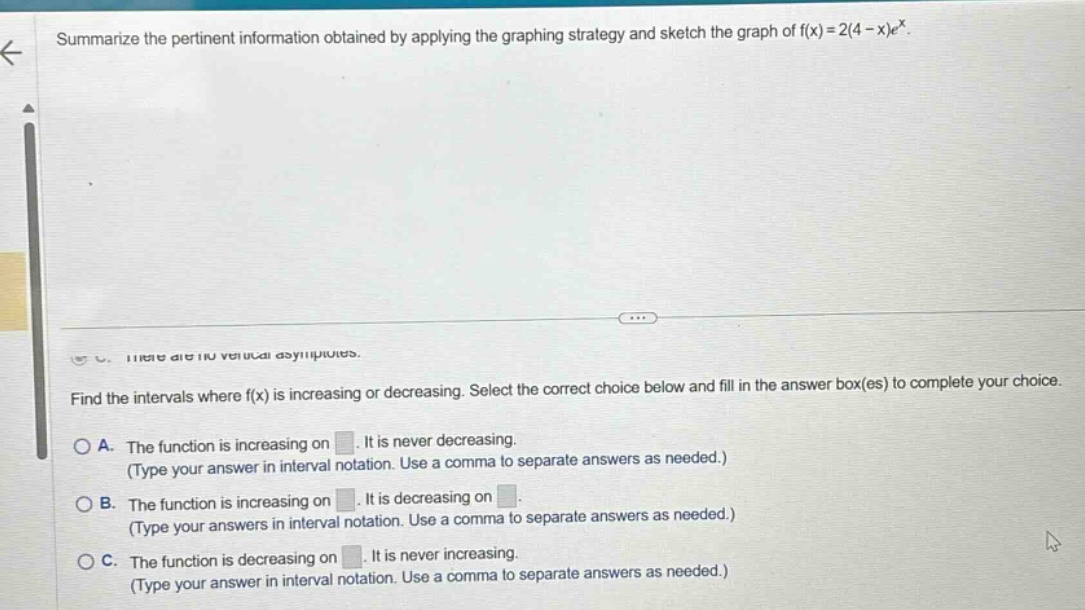
summarize the pertinent information obtained by applying the graphing strategy and sketch the graph of f(x)=2(4 - x)e^x. find the intervals where f(x) is increasing or decreasing. select the correct choice below and fill in the answer box(es) to complete your choice. a. the function is increasing on. it is never decreasing. (type your answer in interval notation. use a comma to separate answers as needed.) b. the function is increasing on. it is decreasing on. (type your answers in interval notation. use a comma to separate answers as needed.) c. the function is decreasing on. it is never increasing. (type your answer in interval notation. use a comma to separate answers as needed.)
Answer
Explanation:
Step1: Find the derivative of (f(x))
Use the product - rule ((uv)^\prime = u^\prime v+uv^\prime), where (u = 2(4 - x)=8 - 2x) and (v = e^{x}). Then (u^\prime=-2) and (v^\prime = e^{x}). So (f^\prime(x)=-2e^{x}+(8 - 2x)e^{x}=e^{x}(6 - 2x)).
Step2: Find the critical points
Set (f^\prime(x)=0), so (e^{x}(6 - 2x)=0). Since (e^{x}>0) for all real (x), then (6 - 2x = 0), which gives (x = 3).
Step3: Determine the intervals of increase and decrease
Choose a test - point in the interval ((-\infty,3)), say (x = 0). Then (f^\prime(0)=e^{0}(6-2\times0)=6>0), so (f(x)) is increasing on ((-\infty,3)). Choose a test - point in the interval ((3,\infty)), say (x = 4). Then (f^\prime(4)=e^{4}(6 - 2\times4)=-2e^{4}<0), so (f(x)) is decreasing on ((3,\infty)).
Answer:
B. The function is increasing on ((-\infty,3)). It is decreasing on ((3,\infty))