summarize the pertinent information obtained by applying the graphing strategy and sketch the graph of…
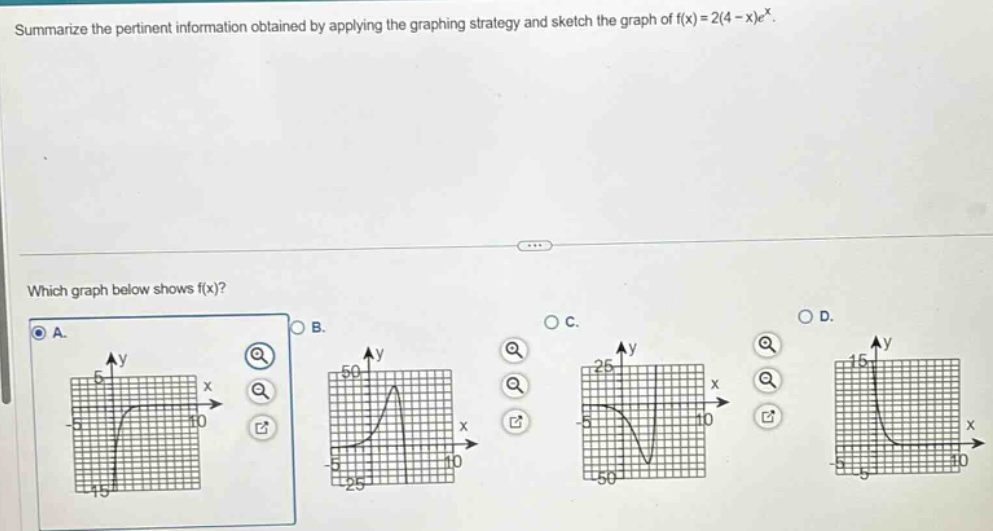
summarize the pertinent information obtained by applying the graphing strategy and sketch the graph of f(x)=2(4 - x)e^x. which graph below shows f(x)?
Answer
Explanation:
Step1: Find the y - intercept
Set (x = 0). Then (f(0)=2(4 - 0)e^{0}=2\times4\times1 = 8).
Step2: Find the x - intercept
Set (f(x)=0), so (2(4 - x)e^{x}=0). Since (e^{x}\gt0) for all real (x), then (4 - x = 0), and (x = 4).
Step3: Find the first - derivative
Use the product rule ((uv)^\prime=u^\prime v+uv^\prime), where (u = 2(4 - x)=8 - 2x) and (v = e^{x}). Then (u^\prime=-2) and (v^\prime = e^{x}). So (f^\prime(x)=-2e^{x}+(8 - 2x)e^{x}=e^{x}(6 - 2x)).
Step4: Find critical points
Set (f^\prime(x)=0), then (e^{x}(6 - 2x)=0). Since (e^{x}\gt0) for all real (x), we have (6 - 2x = 0), so (x = 3).
Step5: Determine the intervals of increase and decrease
Test intervals:
- For (x\lt3), let (x = 2), then (f^\prime(2)=e^{2}(6 - 4)=2e^{2}\gt0), so (f(x)) is increasing on ((-\infty,3)).
- For (x\gt3), let (x = 4), then (f^\prime(4)=e^{4}(6 - 8)=-2e^{4}\lt0), so (f(x)) is decreasing on ((3,\infty)).
Step6: Find the second - derivative
Use the product rule on (f^\prime(x)=e^{x}(6 - 2x)). Let (u = 6 - 2x), (u^\prime=-2), (v = e^{x}), (v^\prime = e^{x}). Then (f^{\prime\prime}(x)=-2e^{x}+(6 - 2x)e^{x}=e^{x}(4 - 2x)).
Step7: Find inflection points
Set (f^{\prime\prime}(x)=0), then (e^{x}(4 - 2x)=0). Since (e^{x}\gt0) for all real (x), we have (4 - 2x = 0), so (x = 2).
- For (x\lt2), let (x = 1), then (f^{\prime\prime}(1)=e^{1}(4 - 2)=2e\gt0), so the graph is concave up on ((-\infty,2)).
- For (x\gt2), let (x = 3), then (f^{\prime\prime}(3)=e^{3}(4 - 6)=-2e^{3}\lt0), so the graph is concave down on ((2,\infty)).
Step8: Analyze end - behavior
As (x\to-\infty), (f(x)=2(4 - x)e^{x}\to0) (because (e^{x}\to0) faster than (4 - x) grows negatively). As (x\to\infty), (f(x)=2(4 - x)e^{x}\to-\infty) (because (e^{x}) grows much faster than (4 - x) decreases).
Based on the above - mentioned analysis:
- The function has a y - intercept at ((0,8)), an x - intercept at ((4,0)), a maximum at (x = 3) ((f(3)=2(4 - 3)e^{3}=2e^{3}\approx40.17)), an inflection point at (x = 2). It is increasing on ((-\infty,3)), decreasing on ((3,\infty)), concave up on ((-\infty,2)) and concave down on ((2,\infty)).
The graph that matches these characteristics is B.
Answer:
B.