summarize the pertinent information obtained by applying the graphing strategy and sketch the graph of y =…
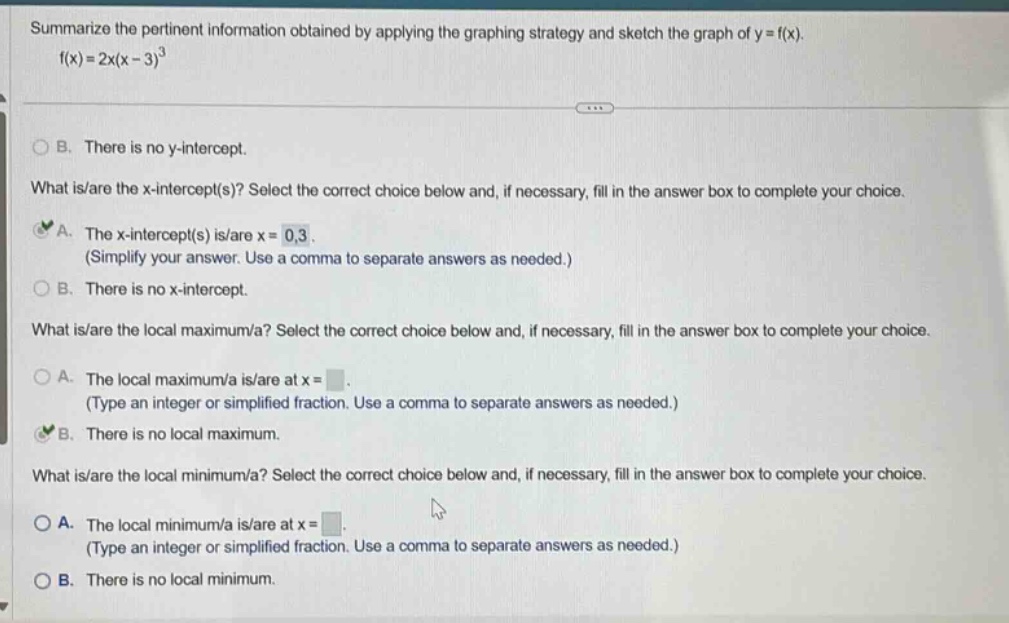
summarize the pertinent information obtained by applying the graphing strategy and sketch the graph of y = f(x). f(x)=2x(x - 3)^3 b. there is no y - intercept. what is/are the x - intercept(s)? select the correct choice below and, if necessary, fill in the answer box to complete your choice. a. the x - intercept(s) is/are x = 0,3. (simplify your answer. use a comma to separate answers as needed.) b. there is no x - intercept. what is/are the local maximum/a? select the correct choice below and, if necessary, fill in the answer box to complete your choice. a. the local maximum/a is/are at x =. (type an integer or simplified fraction. use a comma to separate answers as needed.) b. there is no local maximum. what is/are the local minimum/a? select the correct choice below and, if necessary, fill in the answer box to complete your choice. a. the local minimum/a is/are at x =. (type an integer or simplified fraction. use a comma to separate answers as needed.) b. there is no local minimum.
Answer
Explanation:
Step1: Find y - intercept
Set (x = 0) in (y=f(x)=2x(x - 3)^{3}). Then (y=2\times0\times(0 - 3)^{3}=0), so the y - intercept is (y = 0).
Step2: Find x - intercept
Set (y = 0) in (y=2x(x - 3)^{3}). Then (2x(x - 3)^{3}=0). Using the zero - product property (a\times b=0) implies (a = 0) or (b = 0), we have (2x=0) or ((x - 3)^{3}=0). Solving (2x=0) gives (x = 0) and solving ((x - 3)^{3}=0) gives (x = 3). So the x - intercepts are (x=0,3).
Step3: Find derivative using product rule
The product rule states that if (y = u\times v), where (u = 2x) and (v=(x - 3)^{3}), then (y^\prime=u^\prime v+uv^\prime). (u^\prime=2) and (v^\prime = 3(x - 3)^{2}) by the chain rule. So (y^\prime=2(x - 3)^{3}+2x\times3(x - 3)^{2}=2(x - 3)^{2}[(x - 3)+3x]=2(x - 3)^{2}(4x - 3)).
Step4: Find critical points
Set (y^\prime=0). Then (2(x - 3)^{2}(4x - 3)=0). Using the zero - product property, we get (x = 3) or (x=\frac{3}{4}).
Step5: Use the first - derivative test
Choose test points in the intervals ((-\infty,\frac{3}{4})), ((\frac{3}{4},3)) and ((3,\infty)). For (x = 0) (in ((-\infty,\frac{3}{4}))), (y^\prime=2(0 - 3)^{2}(4\times0 - 3)=2\times9\times(- 3)<0). For (x = 1) (in ((\frac{3}{4},3))), (y^\prime=2(1 - 3)^{2}(4\times1 - 3)=2\times4\times1>0). For (x = 4) (in ((3,\infty))), (y^\prime=2(4 - 3)^{2}(4\times4 - 3)=2\times1\times13>0). Since the function changes from decreasing to increasing at (x=\frac{3}{4}), there is a local minimum at (x=\frac{3}{4}). And since the sign of the derivative does not change at (x = 3), there is no local maximum or minimum at (x = 3).
Answer:
The local minimum is at (x=\frac{3}{4})