summarize the pertinent information obtained by applying the graphing strategy and sketch the graph of y =…
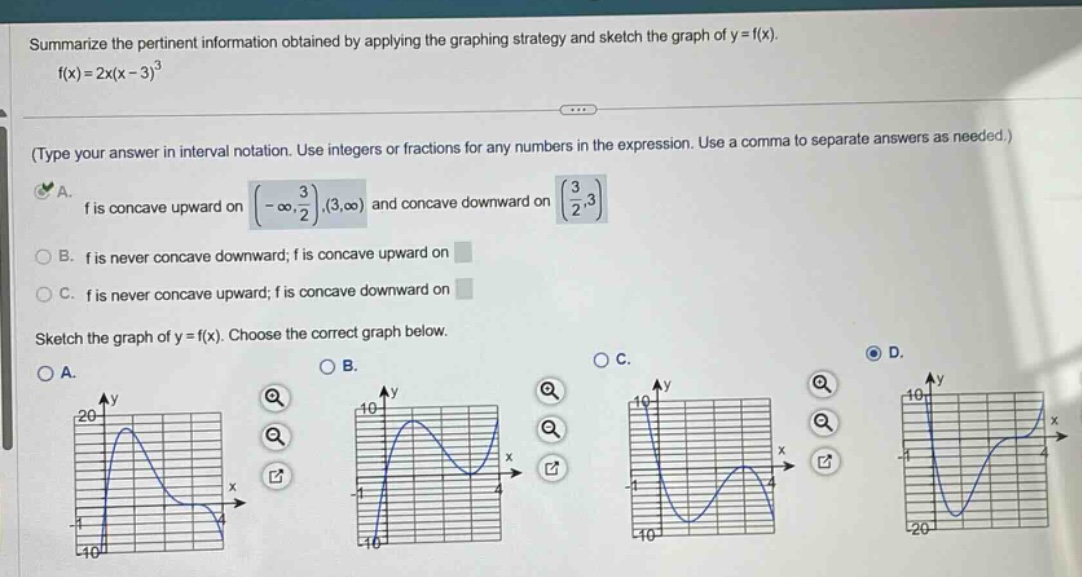
summarize the pertinent information obtained by applying the graphing strategy and sketch the graph of y = f(x). f(x)=2x(x - 3)^3 (type your answer in interval notation. use integers or fractions for any numbers in the expression. use a comma to separate answers as needed.) a. f is concave upward on (-∞, 3/2),(3,∞) and concave downward on (3/2,3) b. f is never concave downward; f is concave upward on c. f is never concave upward; f is concave downward on sketch the graph of y = f(x). choose the correct graph below. a. b. c. d.
Answer
Explanation:
Step1: Find the first - derivative
First, use the product rule $(uv)^\prime = u^\prime v+uv^\prime$, where $u = 2x$ and $v=(x - 3)^3$. $u^\prime=2$ and $v^\prime = 3(x - 3)^2$. Then $f^\prime(x)=2(x - 3)^3+6x(x - 3)^2=(x - 3)^2(2(x - 3)+6x)=(x - 3)^2(2x-6 + 6x)=(x - 3)^2(8x-6)=2(x - 3)^2(4x - 3)$.
Step2: Find the second - derivative
Use the product rule again. Let $u = 2(x - 3)^2$ and $v=4x - 3$. $u^\prime=4(x - 3)$ and $v^\prime = 4$. Then $f^{\prime\prime}(x)=4(x - 3)(4x - 3)+8(x - 3)^2=4(x - 3)[(4x - 3)+2(x - 3)]=4(x - 3)(4x-3 + 2x-6)=4(x - 3)(6x - 9)=12(x - 3)(2x - 3)$.
Step3: Find the inflection points
Set $f^{\prime\prime}(x)=0$. Then $12(x - 3)(2x - 3)=0$. Solving gives $x=\frac{3}{2}$ and $x = 3$.
Step4: Test the intervals for concavity
Choose test points in the intervals $\left(-\infty,\frac{3}{2}\right)$, $\left(\frac{3}{2},3\right)$ and $(3,\infty)$. For the interval $\left(-\infty,\frac{3}{2}\right)$, let $x = 0$. Then $f^{\prime\prime}(0)=12(-3)(- 3)>0$, so the function is concave upward. For the interval $\left(\frac{3}{2},3\right)$, let $x = 2$. Then $f^{\prime\prime}(2)=12(-1)(1)<0$, so the function is concave downward. For the interval $(3,\infty)$, let $x = 4$. Then $f^{\prime\prime}(4)=12(1)(5)>0$, so the function is concave upward.
Answer:
A. $f$ is concave upward on $\left(-\infty,\frac{3}{2}\right),(3,\infty)$ and concave downward on $\left(\frac{3}{2},3\right)$