suppose f(x)=√19x and g(x)=√76x. express the function g as a horizontal compression and then as a vertical…
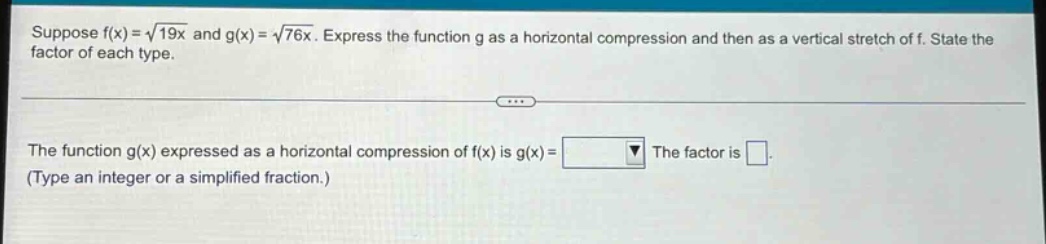
suppose f(x)=√19x and g(x)=√76x. express the function g as a horizontal compression and then as a vertical stretch of f. state the factor of each type. the function g(x) expressed as a horizontal compression of f(x) is g(x)= the factor is. (type an integer or a simplified fraction.)
Answer
Answer:
- For horizontal - compression:
- (g(x)=f(4x)), factor: (4)
- For vertical - stretch:
- (g(x) = 2f(x)), factor: (2)
Explanation:
Step1: Recall transformation rules for horizontal compression
If (y = f(x)) and (y = f(bx)) ((b>0)), the graph of (y = f(bx)) is a horizontal compression of (y = f(x)) by a factor of (\frac{1}{b}). Given (f(x)=\sqrt{19x}) and (g(x)=\sqrt{76x}), we can rewrite (g(x)) as (g(x)=\sqrt{19(4x)}). So (g(x)=f(4x)), and the factor of horizontal compression is (4).
Step2: Recall transformation rules for vertical stretch
If (y = f(x)) and (y = af(x)) ((a > 0)), the graph of (y=af(x)) is a vertical stretch of (y = f(x)) by a factor of (a). Since (f(x)=\sqrt{19x}) and (g(x)=\sqrt{76x}), and (\sqrt{76x}=\sqrt{4\times19x}=2\sqrt{19x}), so (g(x) = 2f(x)), and the factor of vertical stretch is (2).