suppose f(x)= - 0.5·x⁴ + 3x². use a graphing calculator (like desmos ) to graph the function f. a. determine…
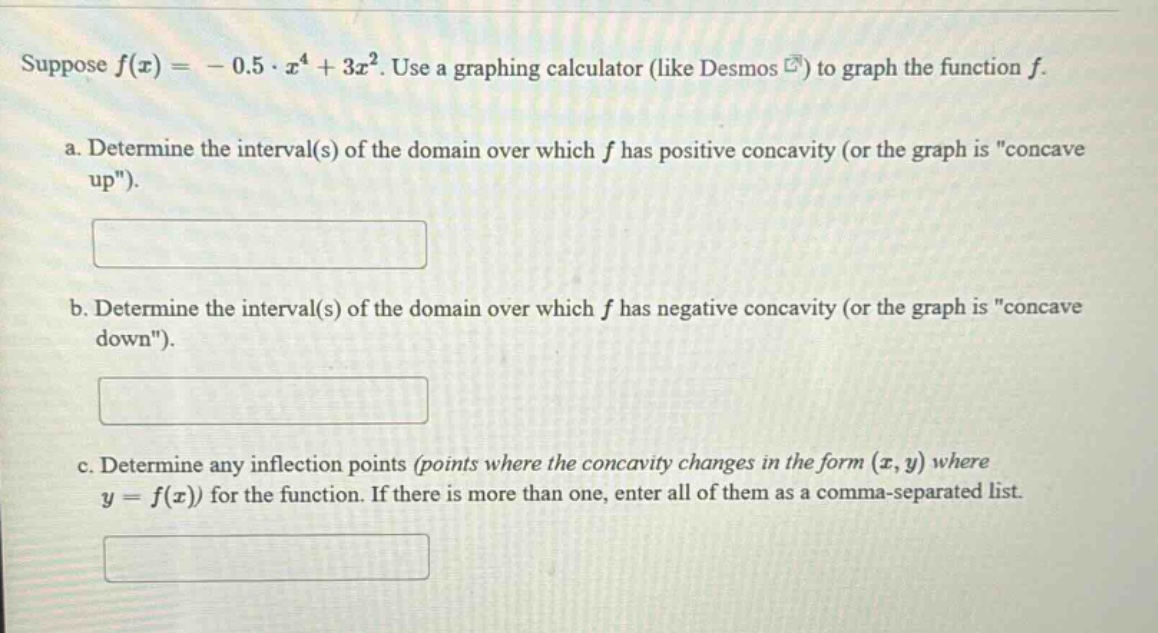
suppose f(x)= - 0.5·x⁴ + 3x². use a graphing calculator (like desmos ) to graph the function f. a. determine the interval(s) of the domain over which f has positive concavity (or the graph is \concave up\). b. determine the interval(s) of the domain over which f has negative concavity (or the graph is \concave down\). c. determine any inflection points (points where the concavity changes in the form (x,y) where y = f(x)) for the function. if there is more than one, enter all of them as a comma - separated list.
Answer
Answer:
a. $(-1,1)$ b. $(-\infty,-1)\cup(1,\infty)$ c. $(-1,2.5),(1,2.5)$
Explanation:
Step1: Find the first - derivative
Given $f(x)=-0.5x^{4}+3x^{2}$. Using the power rule $\frac{d}{dx}(x^{n}) = nx^{n - 1}$, we have $f'(x)=-2x^{3}+6x$.
Step2: Find the second - derivative
Differentiate $f'(x)$ with respect to $x$. $f''(x)=-6x^{2}+6$.
Step3: Find where $f''(x)>0$ (concave up)
Set $f''(x)>0$. So, $-6x^{2}+6 > 0$. Rearrange to get $x^{2}-1<0$, which factors to $(x - 1)(x + 1)<0$. The solution of the inequality is $-1<x<1$.
Step4: Find where $f''(x)<0$ (concave down)
Set $f''(x)<0$. So, $-6x^{2}+6<0$. Rearrange to $x^{2}-1>0$, which factors to $(x - 1)(x + 1)>0$. The solution is $x<-1$ or $x>1$.
Step5: Find inflection points
Set $f''(x)=0$. So, $-6x^{2}+6 = 0$. Solve for $x$: $x^{2}=1$, then $x=\pm1$. Substitute $x = 1$ and $x=-1$ into $f(x)$: $f(1)=-0.5\times1^{4}+3\times1^{2}=2.5$ and $f(-1)=-0.5\times(-1)^{4}+3\times(-1)^{2}=2.5$. So the inflection points are $(-1,2.5)$ and $(1,2.5)$.