suppose f(x) is a continuous function with a continuous derivative, with domain -∞ < x < ∞. a portion of the…
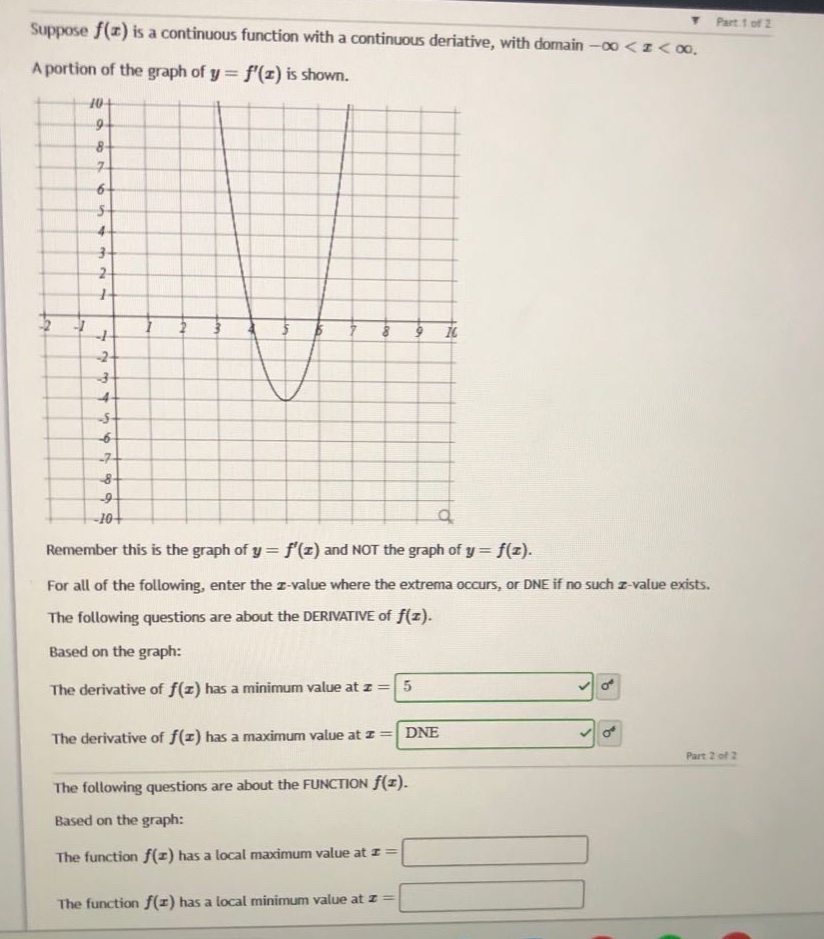
suppose f(x) is a continuous function with a continuous derivative, with domain -∞ < x < ∞. a portion of the graph of y = f(x) is shown. remember this is the graph of y = f(x) and not the graph of y = f(x). for all of the following, enter the x - value where the extrema occurs, or dne if no such x - value exists. the following questions are about the derivative of f(x). based on the graph: the derivative of f(x) has a minimum value at x = 5. the derivative of f(x) has a maximum value at x = dne. the following questions are about the function f(x). based on the graph: the function f(x) has a local maximum value at x = the function f(x) has a local minimum value at x =
Answer
Explanation:
Step1: Recall the relationship between $f(x)$ and $f'(x)$
Local extrema of $f(x)$ occur where $f'(x)=0$ and $f'(x)$ changes sign.
Step2: Find where $f'(x) = 0$
From the graph of $y = f'(x)$, $f'(x)=0$ at $x = 4$ and $x=6$.
Step3: Analyze the sign - change of $f'(x)$
To the left of $x = 4$, $f'(x)>0$, and to the right of $x = 4$, $f'(x)<0$. So $f(x)$ has a local maximum at $x = 4$ since $f(x)$ is increasing when $f'(x)>0$ and decreasing when $f'(x)<0$. To the left of $x = 6$, $f'(x)<0$, and to the right of $x = 6$, $f'(x)>0$. So $f(x)$ has a local minimum at $x = 6$ since $f(x)$ is decreasing when $f'(x)<0$ and increasing when $f'(x)>0$.
Answer:
The function $f(x)$ has a local maximum value at $x = 4$. The function $f(x)$ has a local minimum value at $x = 6$.