suppose f(x) is a continuous function with a continuous derivative, with domain -∞ < x < ∞. a portion of the…
suppose f(x) is a continuous function with a continuous derivative, with domain -∞ < x < ∞. a portion of the graph of y = f(x) is shown. remember this is the graph of y = f(x) and not the graph of y = f(x). for all of the following, enter the x - value where the extrema occurs, or dne if no such x - value exists. the following questions are about the derivative of f(x). based on the graph: the derivative of f(x) has a maximum value at x = the derivative of f(x) has a minimum value at x = the following questions are about the function f(x). based on the graph: the function f(x) has a local maximum value at x = the function f(x) has a local minimum value at x =
Answer
Explanation:
Step1: Recall derivative - extrema relationship
The extrema of a function (y = f'(x)) occur where ((f'(x))'=f''(x) = 0) and the second - derivative of (f'(x)) changes sign. The extrema of (y = f(x)) occur where (f'(x)=0) and (f'(x)) changes sign.
Step2: Find extrema of (f'(x))
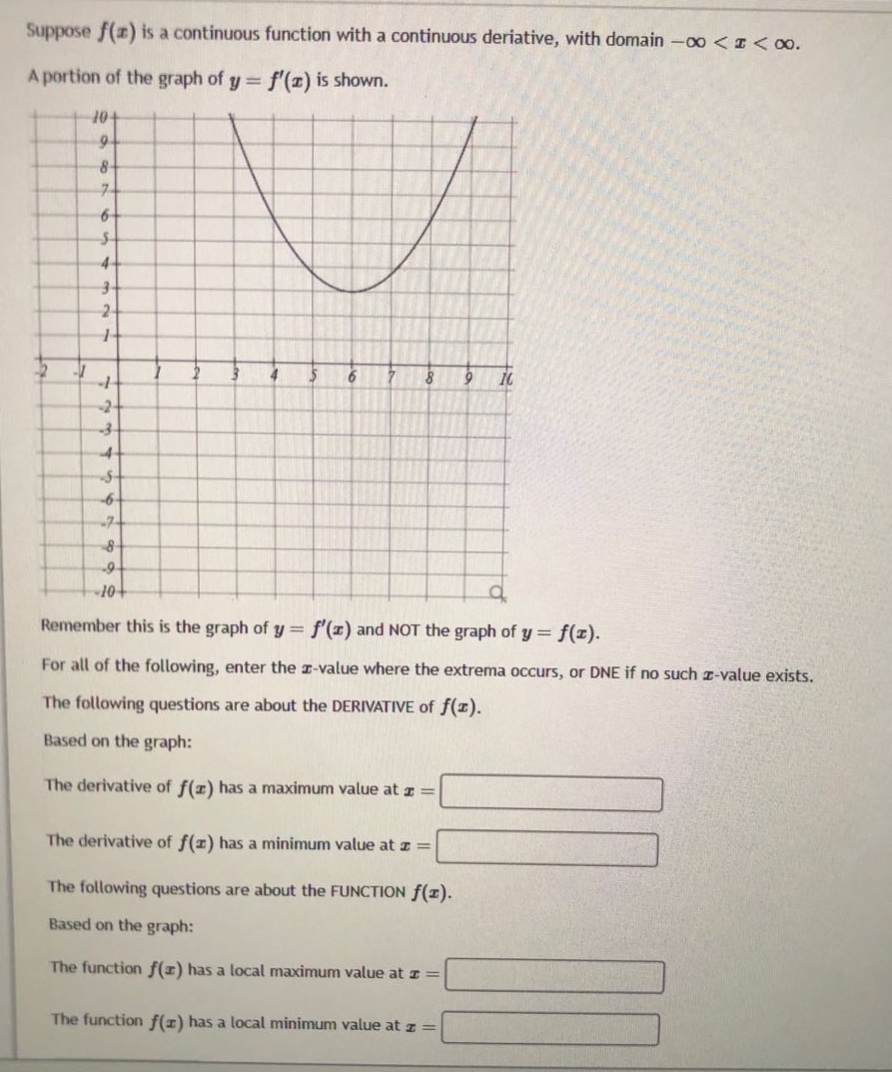
Looking at the graph of (y = f'(x)), the maximum of (y = f'(x)) occurs at the endpoints (since the graph is open - ended). But if we consider the local behavior, the function (y = f'(x)) has a minimum at the vertex of the parabola - like shape. From the graph, the (x) - value of the minimum of (y = f'(x)) is (x = 6). There is no local maximum for (y = f'(x)) in the visible part of the graph, so we can say DNE for the maximum of (f'(x)) (assuming no other parts of the graph outside the visible range).
Step3: Find extrema of (f(x))
The function (y = f(x)) has a local maximum when (f'(x)) changes from positive to negative. The function (y = f(x)) has a local minimum when (f'(x)) changes from negative to positive. From the graph of (y = f'(x)), (f'(x)) is negative for (x<3) and positive for (x > 3), so (f(x)) has a local minimum at (x = 3). Also, (f'(x)) is positive for (x<9) and negative for (x>9) (assuming the trend continues), so (f(x)) has a local maximum at (x = 9).
Answer:
The derivative of (f(x)) has a maximum value at (x=\text{DNE}) The derivative of (f(x)) has a minimum value at (x = 6) The function (f(x)) has a local maximum value at (x = 9) The function (f(x)) has a local minimum value at (x = 3)