suppose f is continuous on an interval containing a critical point c and f(c)=0. how do you determine…
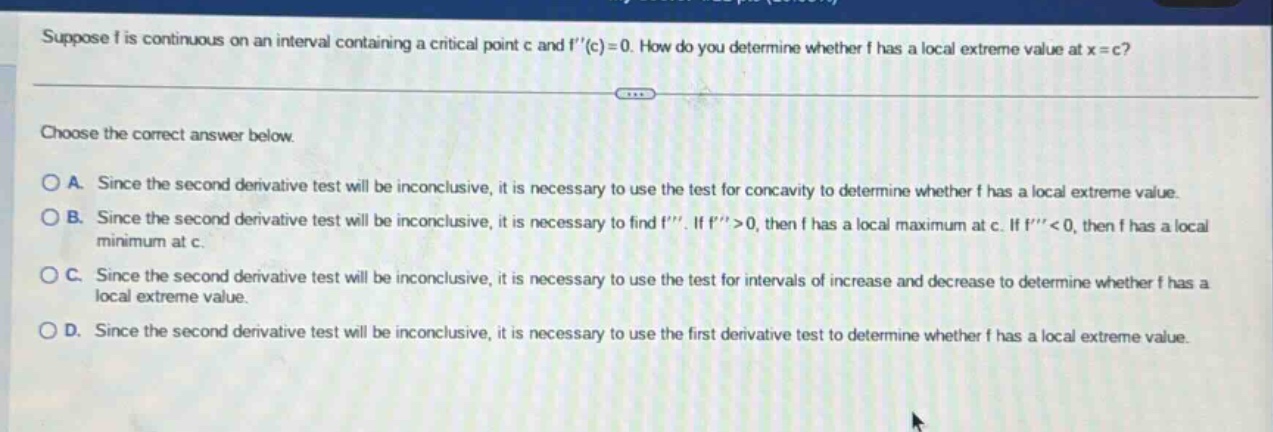
suppose f is continuous on an interval containing a critical point c and f(c)=0. how do you determine whether f has a local extreme value at x = c? choose the correct answer below. a. since the second derivative test will be inconclusive, it is necessary to use the test for concavity to determine whether f has a local extreme value. b. since the second derivative test will be inconclusive, it is necessary to find f. if f>0, then f has a local maximum at c. if f<0, then f has a local minimum at c. c. since the second derivative test will be inconclusive, it is necessary to use the test for intervals of increase and decrease to determine whether f has a local extreme value. d. since the second derivative test will be inconclusive, it is necessary to use the first derivative test to determine whether f has a local extreme value.
Answer
Brief Explanations:
The second - derivative test is inconclusive when (f''(c)=0). In such a case, the first - derivative test can be used to check the sign change of (f'(x)) around (x = c) to determine if (f) has a local extreme value. If (f'(x)) changes sign at (x = c), then (f) has a local extreme value at (x = c).
Answer:
D. Since the second derivative test will be inconclusive, it is necessary to use the first derivative test to determine whether f has a local extreme value.