suppose f(x) is defined as shown below. a. use the continuity checklist to show that f is not continuous at…
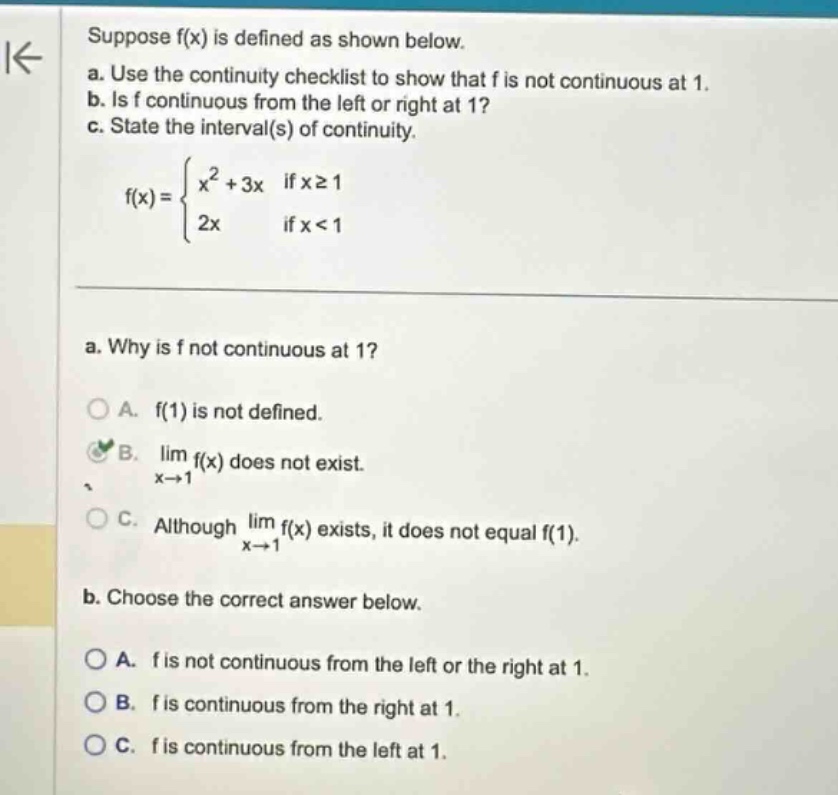
suppose f(x) is defined as shown below. a. use the continuity checklist to show that f is not continuous at 1. b. is f continuous from the left or right at 1? c. state the interval(s) of continuity. f(x) = { x^2 + 3x if x >= 1; 2x if x < 1 } a. why is f not continuous at 1? a. f(1) is not defined. b. lim f(x) as x->1 does not exist. c. although lim f(x) as x->1 exists, it does not equal f(1). b. choose the correct answer below. a. f is not continuous from the left or the right at 1. b. f is continuous from the right at 1. c. f is continuous from the left at 1.
Answer
Explanation:
Step1: Calculate left - hand limit
For (x\lt1), (f(x) = 2x). So, (\lim_{x\rightarrow1^{-}}f(x)=\lim_{x\rightarrow1^{-}}2x = 2\times1=2).
Step2: Calculate right - hand limit
For (x\geq1), (f(x)=x^{2}+3x). So, (\lim_{x\rightarrow1^{+}}f(x)=\lim_{x\rightarrow1^{+}}(x^{2}+3x)=1^{2}+3\times1=4). Since (\lim_{x\rightarrow1^{-}}f(x)=2) and (\lim_{x\rightarrow1^{+}}f(x)=4), (\lim_{x\rightarrow1}f(x)) does not exist.
Step3: Check continuity from the left
(\lim_{x\rightarrow1^{-}}f(x) = 2) and (f(1)=1^{2}+3\times1 = 4). The left - hand limit (\lim_{x\rightarrow1^{-}}f(x)=2) and (f(x)) for (x\lt1) is (2x). The function is continuous for (x\lt1) as (y = 2x) is a linear function. To check left - continuity at (x = 1), (\lim_{x\rightarrow1^{-}}f(x)=2\neq f(1) = 4).
Step4: Check continuity from the right
(\lim_{x\rightarrow1^{+}}f(x)=4) and (f(1)=4). Since (\lim_{x\rightarrow1^{+}}f(x)=f(1)), the function is continuous from the right at (x = 1).
Step5: Find intervals of continuity
The function (y = 2x) is continuous for (x\lt1) and (y=x^{2}+3x) is continuous for (x\geq1). So the intervals of continuity are ((-\infty,1)) and ([1,\infty)), or in other words, ((-\infty,\infty)) with the function being non - continuous in the sense of two - sided limit at (x = 1).
Answer:
a. B. (\lim_{x\rightarrow1}f(x)) does not exist. b. B. (f) is continuous from the right at (1). c. ((-\infty,\infty))