suppose f(t) has the derivative f(t) shown below, and f(0) = 6. find values for f(1) and f(7) f(1) = f(7) =…
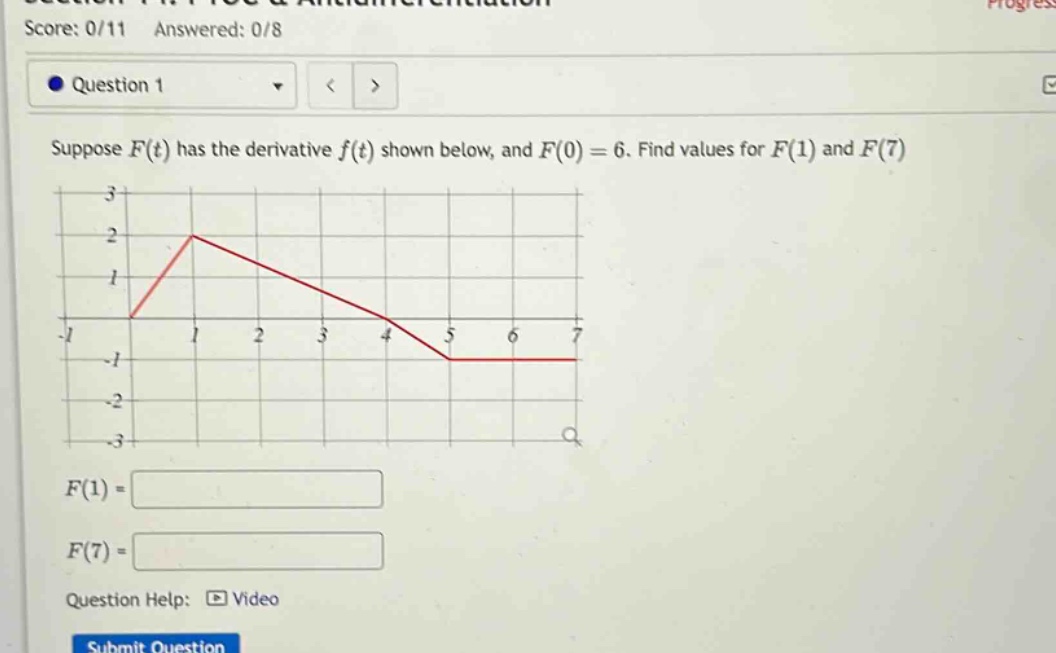
suppose f(t) has the derivative f(t) shown below, and f(0) = 6. find values for f(1) and f(7) f(1) = f(7) = question help: video submit question
Answer
Explanation:
Step1: Recall the fundamental theorem of calculus
By the fundamental theorem of calculus, $F(x)-F(0)=\int_{0}^{x}f(t)dt$. So $F(x)=F(0)+\int_{0}^{x}f(t)dt$.
Step2: Calculate $F(1)$
The area under the curve $y = f(t)$ from $t = 0$ to $t=1$ is the area of a right - triangle. The base of the triangle is $1$ and the height is $2$. The area of a triangle is $A=\frac{1}{2}\times base\times height$. So $\int_{0}^{1}f(t)dt=\frac{1}{2}\times1\times2 = 1$. Since $F(0) = 6$, then $F(1)=F(0)+\int_{0}^{1}f(t)dt=6 + 1=7$.
Step3: Calculate $F(7)$
First, find the area from $t = 0$ to $t = 7$.
- Area from $t=0$ to $t = 1$: $\int_{0}^{1}f(t)dt=\frac{1}{2}\times1\times2=1$ (triangle as above).
- Area from $t = 1$ to $t=4$: It is a trapezoid with bases $b_1 = 2$ and $b_2=0$ and height $h = 3$. The area of a trapezoid $A=\frac{(b_1 + b_2)h}{2}=\frac{(2 + 0)\times3}{2}=3$.
- Area from $t = 4$ to $t=7$: It is a rectangle with base $b=3$ and height $h=- 1$. The area of the rectangle $A=3\times(-1)=-3$. The total area $\int_{0}^{7}f(t)dt=1 + 3-3=1$. Since $F(0)=6$, then $F(7)=F(0)+\int_{0}^{7}f(t)dt=6 + 1=7$.
Answer:
$F(1)=7$ $F(7)=7$