suppose fl(x) is the linearization at x = 3 for the function f(x). for additional information, f(x) is…
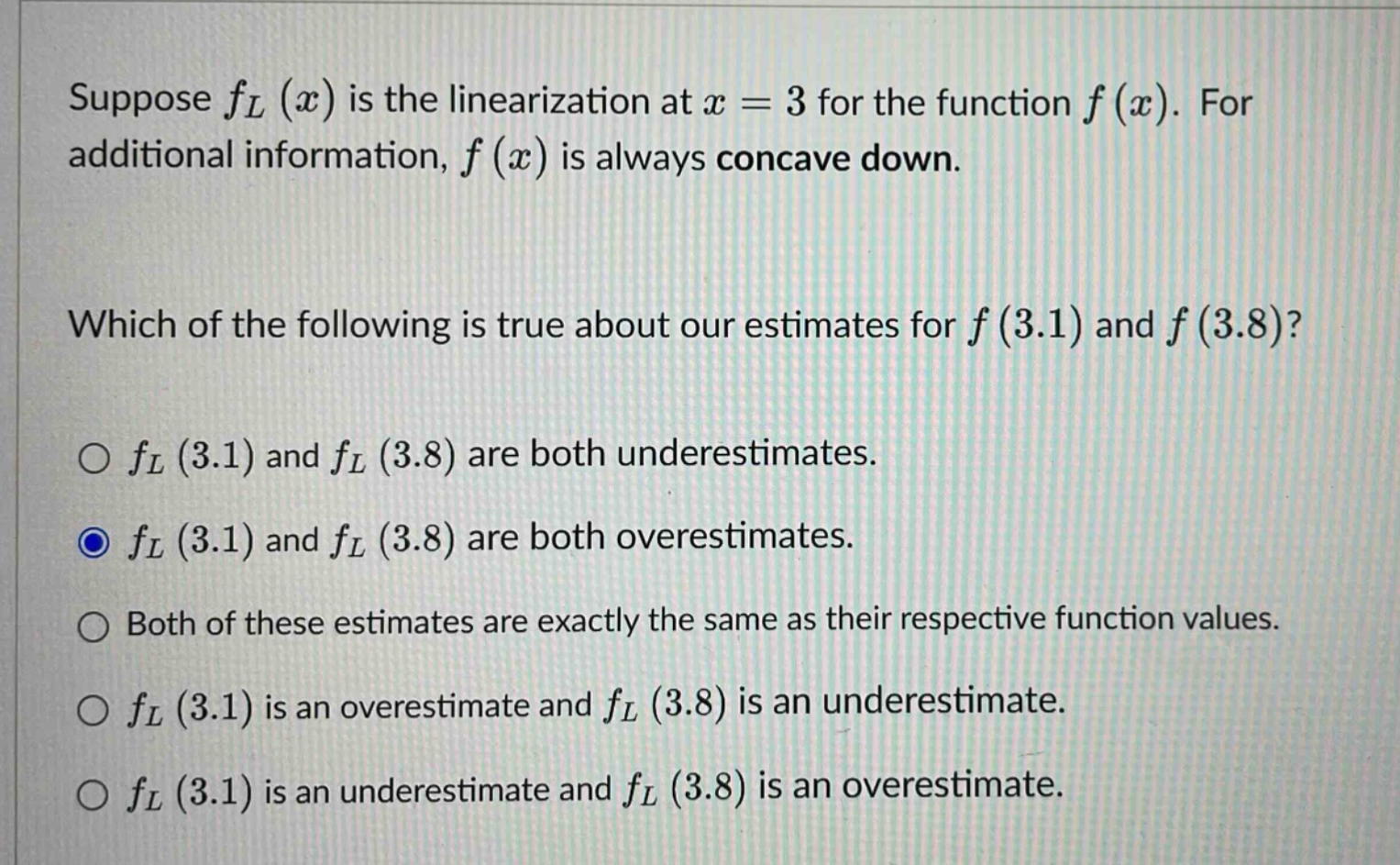
suppose fl(x) is the linearization at x = 3 for the function f(x). for additional information, f(x) is always concave down. which of the following is true about our estimates for f(3.1) and f(3.8)? o fl(3.1) and fl(3.8) are both underestimates. o fl(3.1) and fl(3.8) are both overestimates. o both of these estimates are exactly the same as their respective function values. o fl(3.1) is an overestimate and fl(3.8) is an underestimate. o fl(3.1) is an underestimate and fl(3.8) is an overestimate.
Answer
Explanation:
Step1: Recall linear - approximation property
The linearization (f_L(x)) of a function (y = f(x)) at (x=a) is given by (f_L(x)=f(a)+f^{\prime}(a)(x - a)). It represents the tangent - line approximation of the function at (x = a).
Step2: Analyze the concavity of the function
A function (y = f(x)) is concave down if (f^{\prime\prime}(x)<0) for all (x) in the domain. When a function is concave down, the tangent line to the function at a point lies above the function.
Step3: Determine the nature of the estimates
Since (f(x)) is concave down and (f_L(x)) is the tangent - line approximation of (f(x)) at (x = 3), for any (x\neq3) in the neighborhood of (3), the value of (f_L(x)) will be greater than (f(x)). So, for (x = 3.1) and (x = 3.8), (f_L(3.1)>f(3.1)) and (f_L(3.8)>f(3.8)), which means (f_L(3.1)) and (f_L(3.8)) are both overestimates.
Answer:
(f_L(3.1)) and (f_L(3.8)) are both overestimates.