suppose the following expressions resulted from evaluating limits.\nselect all the indeterminate forms.\n□…
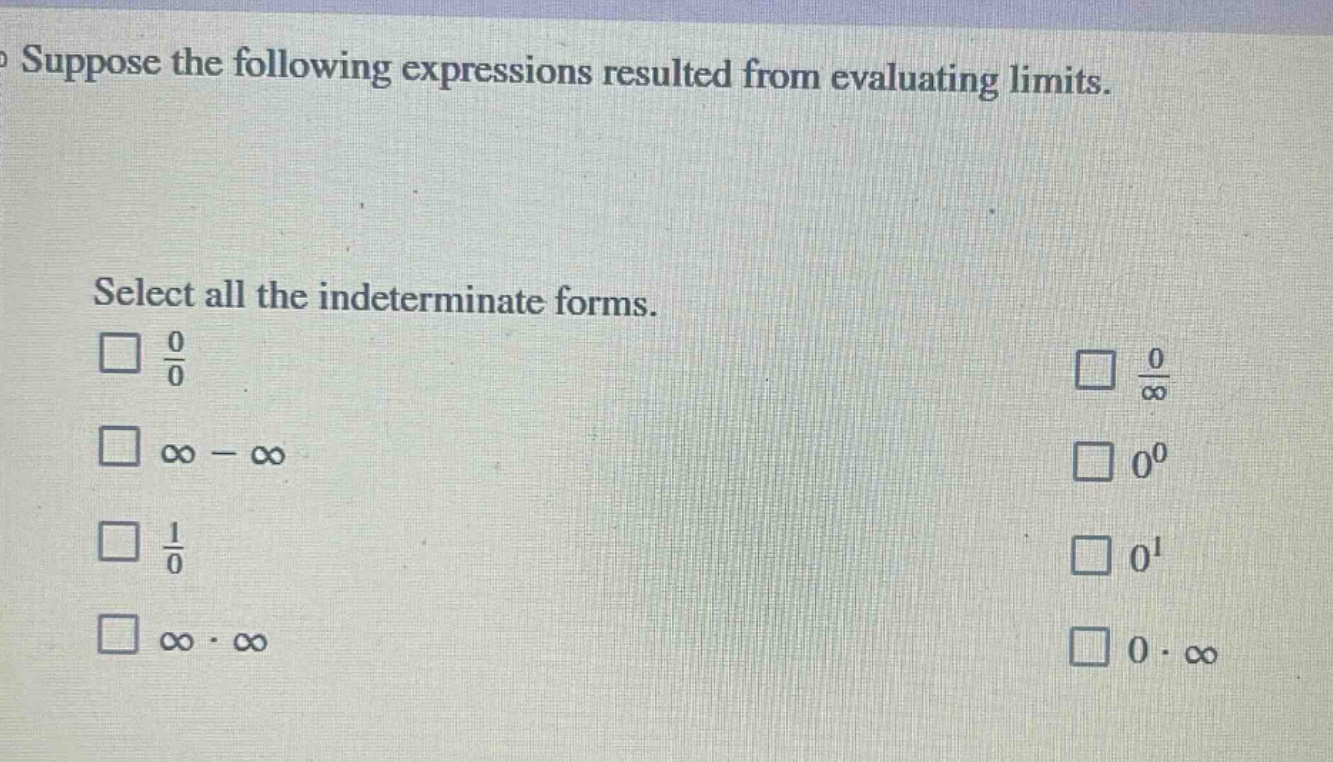
suppose the following expressions resulted from evaluating limits.\nselect all the indeterminate forms.\n□ $\frac{0}{0}$\n□ $infty-infty$\n□ $\frac{1}{0}$\n□ $inftycdotinfty$\n□ $\frac{0}{infty}$\n□ $0^{0}$\n□ $0^{1}$\n□ $0cdotinfty$
Answer
Explanation:
Step1: Recall indeterminate - form definitions
Indeterminate forms in calculus are expressions whose limit value cannot be determined immediately.
Step2: Analyze each form
- $\frac{0}{0}$: This is an indeterminate form. For example, $\lim_{x\rightarrow a}\frac{f(x)}{g(x)}$ where $\lim_{x\rightarrow a}f(x)=0$ and $\lim_{x\rightarrow a}g(x)=0$ can have different values depending on $f(x)$ and $g(x)$.
- $\frac{0}{\infty}$: This is not an indeterminate form. Since the numerator is 0 and the denominator is going to infinity, $\lim_{x\rightarrow a}\frac{0}{h(x)} = 0$ when $\lim_{x\rightarrow a}h(x)=\infty$.
- $\infty-\infty$: This is an indeterminate form. For example, $\lim_{x\rightarrow\infty}(x-(x + 1))=- 1$ and $\lim_{x\rightarrow\infty}(x - x)=0$, so the result of $\infty-\infty$ is not well - defined without further analysis.
- $0^{0}$: This is an indeterminate form. For example, $\lim_{x\rightarrow0^{+}}x^{x}=1$ and $\lim_{x\rightarrow0^{+}}(0)^{x}=0$, so the value of $0^{0}$ is not uniquely determined.
- $\frac{1}{0}$: This is not an indeterminate form. It is either $+\infty$ or $-\infty$ depending on the sign of the denominator as it approaches 0.
- $0^{1}$: This is not an indeterminate form. $0^{1}=0$.
- $\infty\cdot\infty$: This is not an indeterminate form. $\infty\cdot\infty=\infty$.
- $0\cdot\infty$: This is an indeterminate form. For example, $\lim_{x\rightarrow\infty}\frac{1}{x}\cdot x = 1$ and $\lim_{x\rightarrow\infty}\frac{1}{x^{2}}\cdot x = 0$, so the value of $0\cdot\infty$ is not well - defined without more information.
Answer:
$\frac{0}{0}$, $\infty-\infty$, $0^{0}$, $0\cdot\infty$