2) suppose the function h(t)= - 5t² + 10t + 3 models the height of a diver above the water (in meters), t…
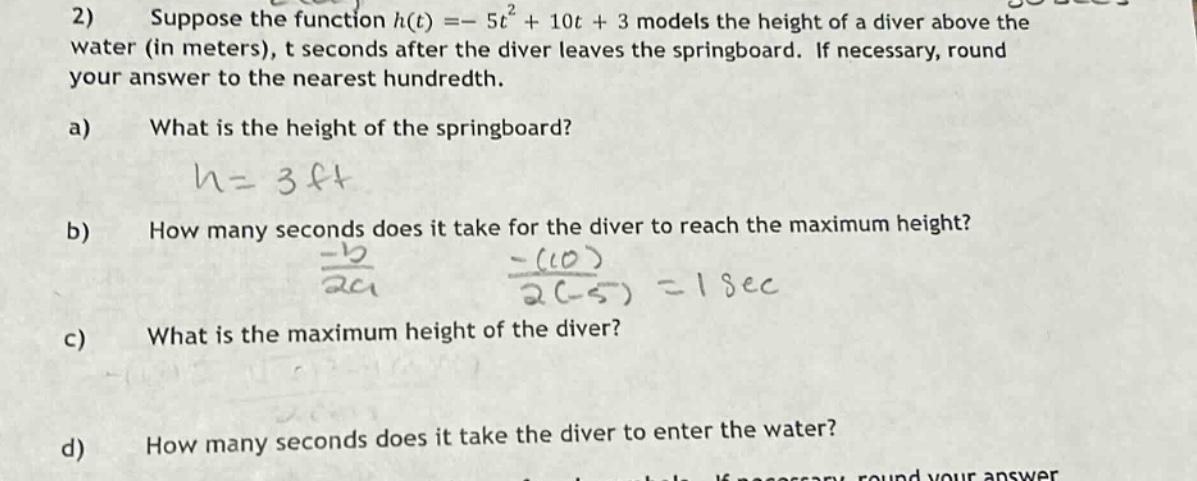
2) suppose the function h(t)= - 5t² + 10t + 3 models the height of a diver above the water (in meters), t seconds after the diver leaves the springboard. if necessary, round your answer to the nearest hundredth. a) what is the height of the springboard? b) how many seconds does it take for the diver to reach the maximum height? c) what is the maximum height of the diver? d) how many seconds does it take the diver to enter the water?
Answer
Explanation:
Step1: Find spring - board height
When the diver leaves the springboard, (t = 0). Substitute (t = 0) into (h(t)=-5t^{2}+10t + 3). [h(0)=-5(0)^{2}+10(0)+3=3]
Step2: Find time to reach maximum height
The function (h(t)=-5t^{2}+10t + 3) is a quadratic function in the form (y = ax^{2}+bx + c) where (a=-5), (b = 10), (c = 3). The time (t) at which the maximum occurs is given by (t=-\frac{b}{2a}). [t=-\frac{10}{2\times(-5)} = 1]
Step3: Find maximum height
Substitute (t = 1) into (h(t)). [h(1)=-5(1)^{2}+10(1)+3=-5 + 10+3=8]
Step4: Find time to enter water
When the diver enters the water, (h(t)=0). So we solve the quadratic equation (-5t^{2}+10t + 3=0). Using the quadratic formula (t=\frac{-b\pm\sqrt{b^{2}-4ac}}{2a}), where (a=-5), (b = 10), (c = 3). [t=\frac{-10\pm\sqrt{10^{2}-4\times(-5)\times3}}{2\times(-5)}=\frac{-10\pm\sqrt{100 + 60}}{-10}=\frac{-10\pm\sqrt{160}}{-10}=\frac{-10\pm4\sqrt{10}}{-10}] We take the positive root since time cannot be negative. [t=\frac{-10 + 4\sqrt{10}}{-10}\approx\frac{-10+4\times3.1623}{-10}=\frac{-10 + 12.6492}{-10}=\frac{2.6492}{-10}\text{(wrong sign)}] [t=\frac{-10-4\sqrt{10}}{-10}\approx\frac{-10 - 12.6492}{-10}=\frac{-22.6492}{-10}=2.26]
Answer:
a) 3 meters b) 1 second c) 8 meters d) 2.26 seconds