suppose that the function f is defined, for all real numbers, as follows. f(x) = { -x + 3 if x < -1; -3x + 1…
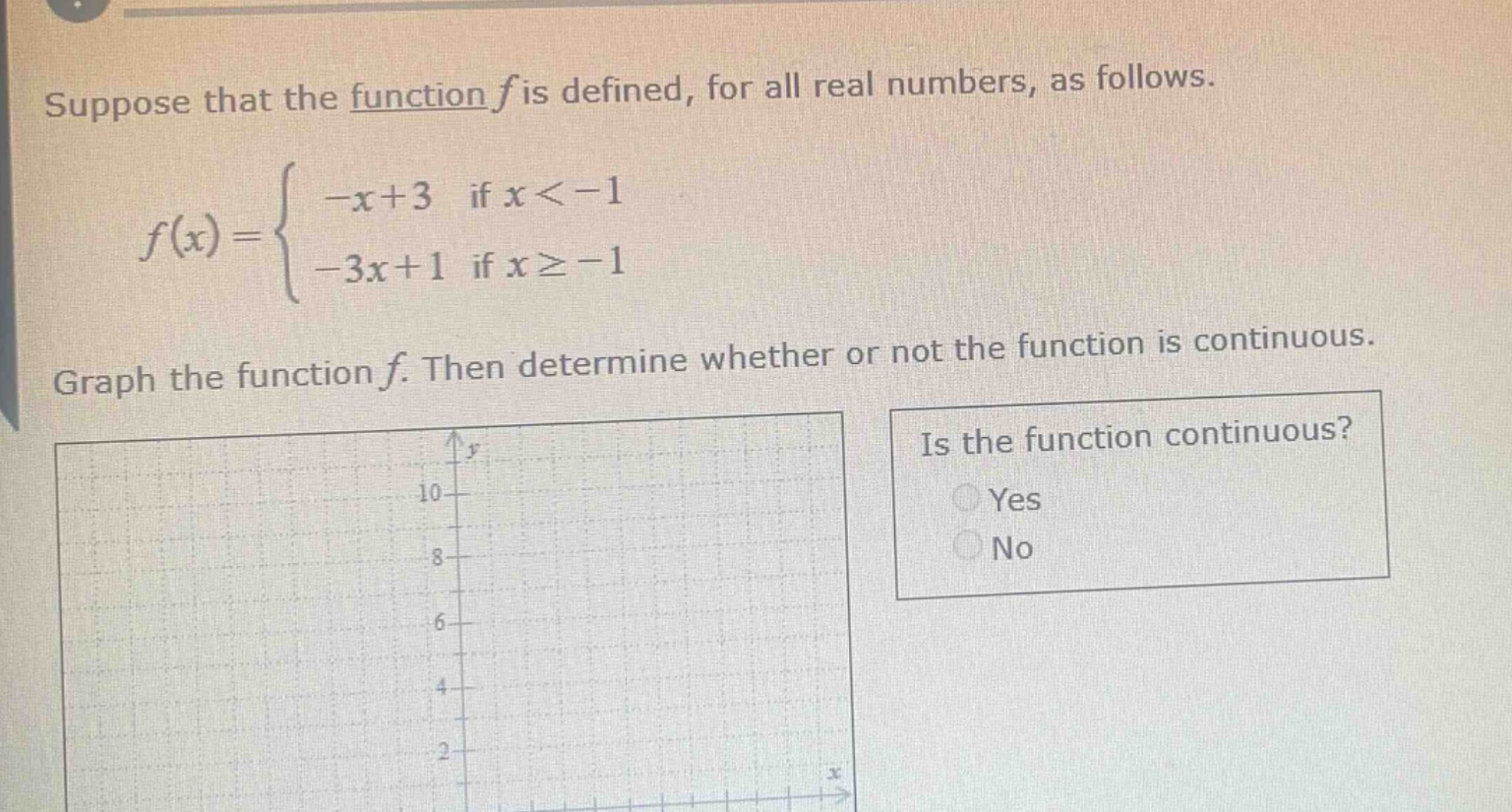
suppose that the function f is defined, for all real numbers, as follows. f(x) = { -x + 3 if x < -1; -3x + 1 if x ≥ -1. graph the function f. then determine whether or not the function is continuous. is the function continuous? yes no
Answer
Explanation:
Step1: Find left - hand limit
As (x\to - 1^{-}), we use (f(x)=-x + 3). (\lim_{x\to - 1^{-}}f(x)=\lim_{x\to - 1^{-}}(-x + 3)=-(-1)+3=4)
Step2: Find right - hand limit
As (x\to - 1^{+}), we use (f(x)=-3x + 1). (\lim_{x\to - 1^{+}}f(x)=\lim_{x\to - 1^{+}}(-3x + 1)=-3\times(-1)+1=4)
Step3: Find function value at (x=-1)
Substitute (x = - 1) into (f(x)=-3x + 1) (since (x=-1) satisfies (x\geq - 1)). (f(-1)=-3\times(-1)+1=4)
Step4: Check continuity condition
Since (\lim_{x\to - 1^{-}}f(x)=\lim_{x\to - 1^{+}}f(x)=f(-1) = 4), the function is continuous at (x=-1). And the two linear - piece functions (y=-x + 3) and (y=-3x + 1) are continuous on their respective domains ((x\lt - 1) and (x\geq - 1)).
Answer:
Yes