suppose that the function f is defined, for all real numbers, as follows. f(x) = { x - 3 if x ≤ - 2; 4x + 5…
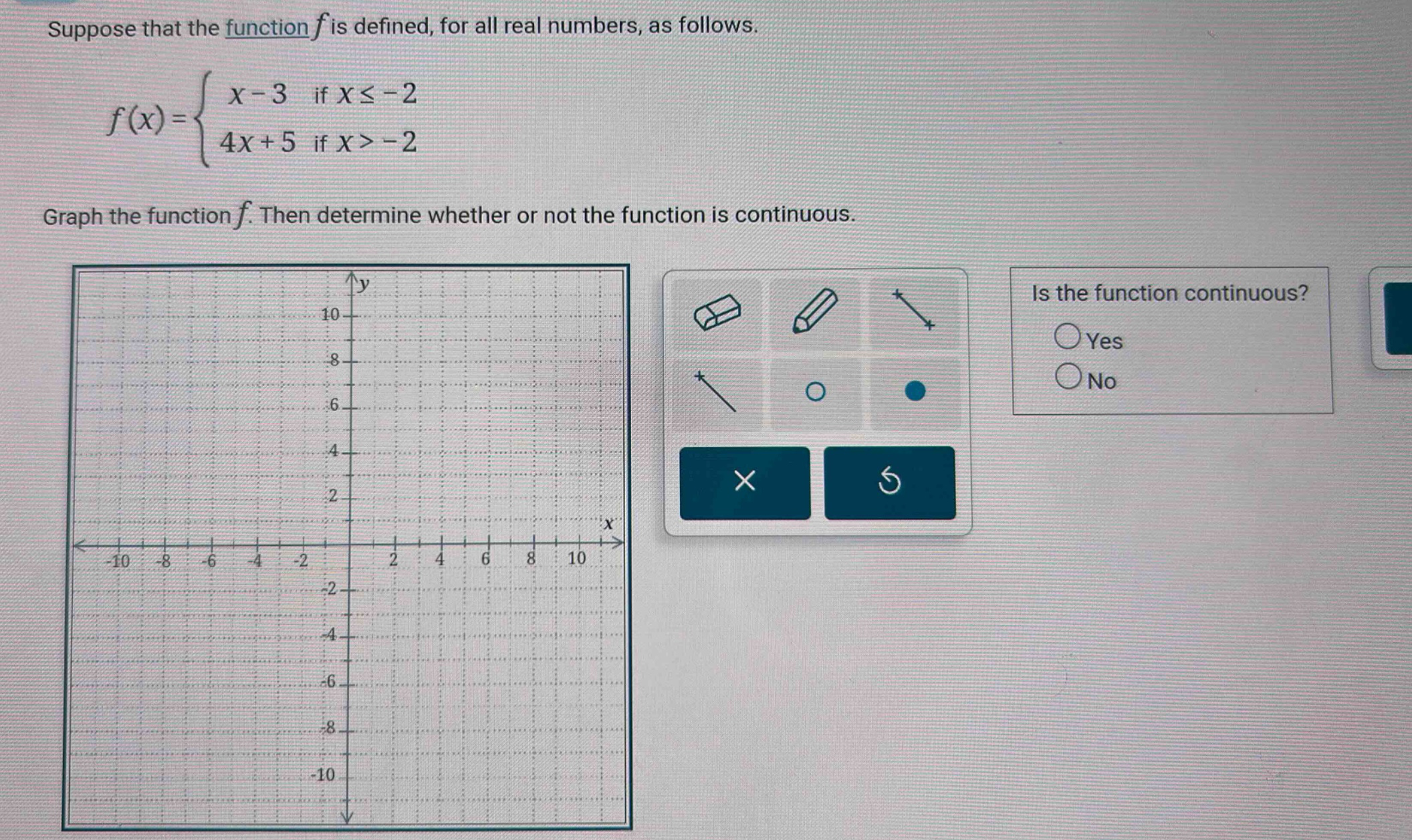
suppose that the function f is defined, for all real numbers, as follows. f(x) = { x - 3 if x ≤ - 2; 4x + 5 if x > - 2 } graph the function f. then determine whether or not the function is continuous. is the function continuous? yes no
Answer
Explanation:
Step1: Encontrar el límite izquierdo en $x = - 2$
Calculamos $\lim_{x\rightarrow - 2^{-}}f(x)$. Como $x\rightarrow - 2^{-}$ significa $x\lt - 2$, usamos $f(x)=x - 3$. Entonces $\lim_{x\rightarrow - 2^{-}}f(x)=-2 - 3=-5$.
Step2: Encontrar el límite derecho en $x = - 2$
Calculamos $\lim_{x\rightarrow - 2^{+}}f(x)$. Como $x\rightarrow - 2^{+}$ significa $x\gt - 2$, usamos $f(x)=4x + 5$. Entonces $\lim_{x\rightarrow - 2^{+}}f(x)=4\times(-2)+5=-8 + 5=-3$.
Step3: Verificar la continuidad
Para que una función sea continua en $x = a$, debe cumplirse que $\lim_{x\rightarrow a^{-}}f(x)=\lim_{x\rightarrow a^{+}}f(x)=f(a)$. Aquí, $\lim_{x\rightarrow - 2^{-}}f(x)=-5$ y $\lim_{x\rightarrow - 2^{+}}f(x)=-3$, y como $\lim_{x\rightarrow - 2^{-}}f(x)\neq\lim_{x\rightarrow - 2^{+}}f(x)$, la función no es continua.
Answer:
No