suppose that the function f is defined, for all real numbers, as follows.\nf(x)=\begin{cases}4x + 3&\text{if…
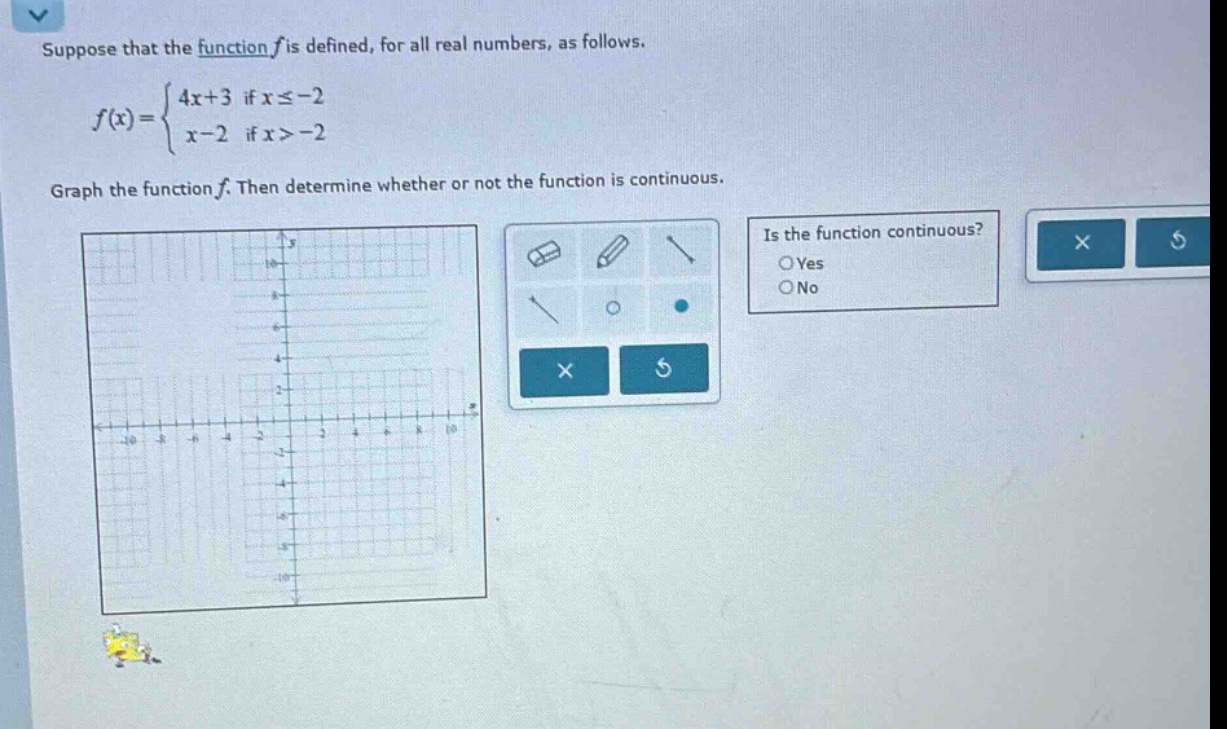
suppose that the function f is defined, for all real numbers, as follows.\nf(x)=\begin{cases}4x + 3&\text{if }xleq - 2\\x - 2&\text{if }x> - 2end{cases}\ngraph the function f. then determine whether or not the function is continuous.\nis the function continuous?\nyes\nno
Answer
Explanation:
Step1: Find the left - hand limit as x approaches - 2
We use the part of the function for (x\leq - 2), (f(x)=4x + 3). (\lim_{x\rightarrow - 2^{-}}f(x)=\lim_{x\rightarrow - 2^{-}}(4x + 3)=4\times(-2)+3=-8 + 3=-5)
Step2: Find the right - hand limit as x approaches - 2
We use the part of the function for (x>-2), (f(x)=x - 2). (\lim_{x\rightarrow - 2^{+}}f(x)=\lim_{x\rightarrow - 2^{+}}(x - 2)=-2-2=-4)
Step3: Evaluate the function at x = - 2
We use the part of the function for (x\leq - 2), (f(-2)=4\times(-2)+3=-5)
Step4: Check the continuity condition
For a function to be continuous at (x = a), (\lim_{x\rightarrow a^{-}}f(x)=\lim_{x\rightarrow a^{+}}f(x)=f(a)). Here, (\lim_{x\rightarrow - 2^{-}}f(x)=-5), (\lim_{x\rightarrow - 2^{+}}f(x)=-4), and since (-5\neq - 4), the function is not continuous.
Answer:
No