suppose a gauge at the outflow of a reservoir measures the flow rate of water in units of ft³/hr. the total…
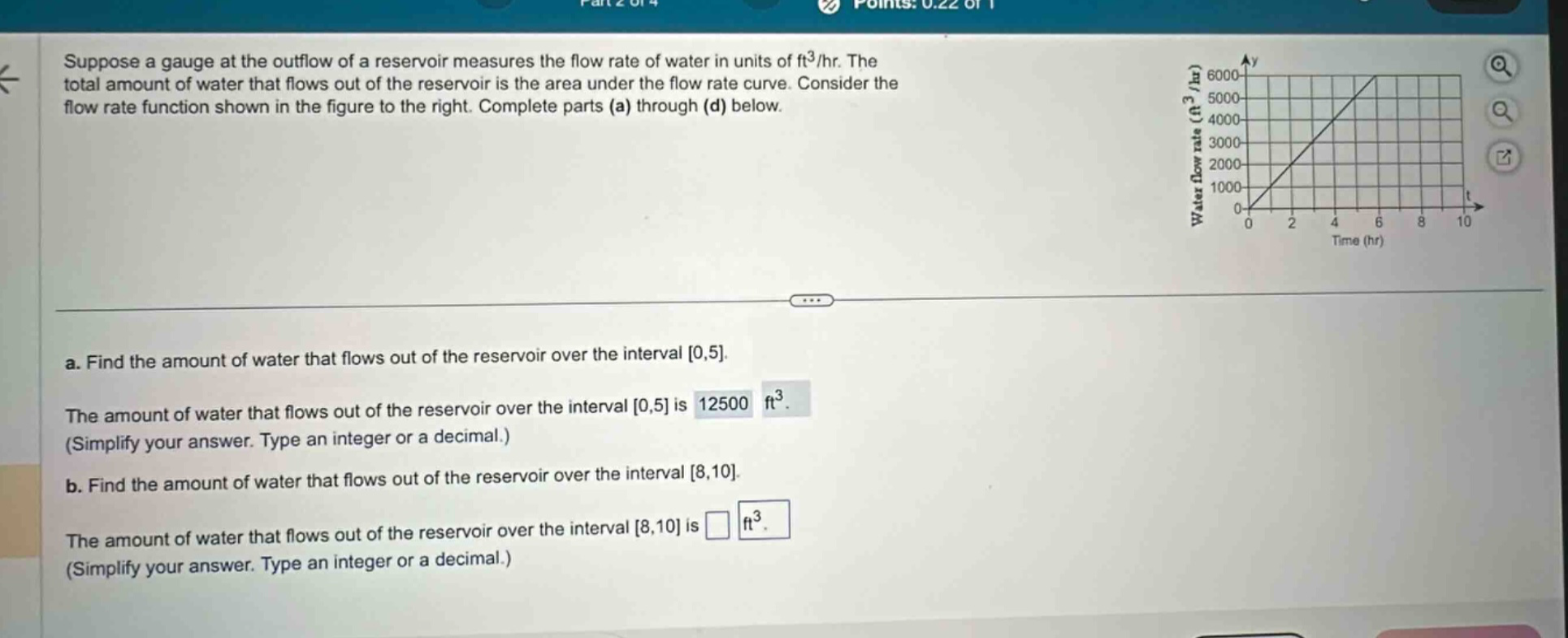
suppose a gauge at the outflow of a reservoir measures the flow rate of water in units of ft³/hr. the total amount of water that flows out of the reservoir is the area under the flow rate curve. consider the flow rate function shown in the figure to the right. complete parts (a) through (d) below. a. find the amount of water that flows out of the reservoir over the interval 0,5. the amount of water that flows out of the reservoir over the interval 0,5 is 12500 ft³. (simplify your answer. type an integer or a decimal.) b. find the amount of water that flows out of the reservoir over the interval 8,10. the amount of water that flows out of the reservoir over the interval 8,10 is ft³. (simplify your answer. type an integer or a decimal.)
Answer
Explanation:
Step1: Determine the flow - rate function
The flow - rate function is a linear function. From the graph, when (t = 0), (y=0); when (t = 6), (y = 6000). The slope (m=\frac{6000 - 0}{6-0}=1000), and the equation of the line is (y = 1000t).
Step2: Calculate the amount of water for ([8,10])
The amount of water that flows out over an interval ([a,b]) is given by the definite integral (\int_{a}^{b}y(t)dt). Here, (y(t)=1000t), (a = 8), (b = 10). So (\int_{8}^{10}1000t\ dt=1000\int_{8}^{10}t\ dt). Using the power - rule for integration (\int t^n\ dt=\frac{t^{n + 1}}{n+1}+C(n\neq - 1)), we have (1000\left[\frac{t^{2}}{2}\right]_{8}^{10}).
Step3: Evaluate the definite integral
[ \begin{align*} 1000\left(\frac{10^{2}}{2}-\frac{8^{2}}{2}\right)&=1000\left(\frac{100}{2}-\frac{64}{2}\right)\ &=1000\times\frac{100 - 64}{2}\ &=1000\times\frac{36}{2}\ &=18000 \end{align*} ]
Answer:
(18000)