suppose a gauge at the outflow of a reservoir measures the flow rate of water in units of ft³/hr. the total…
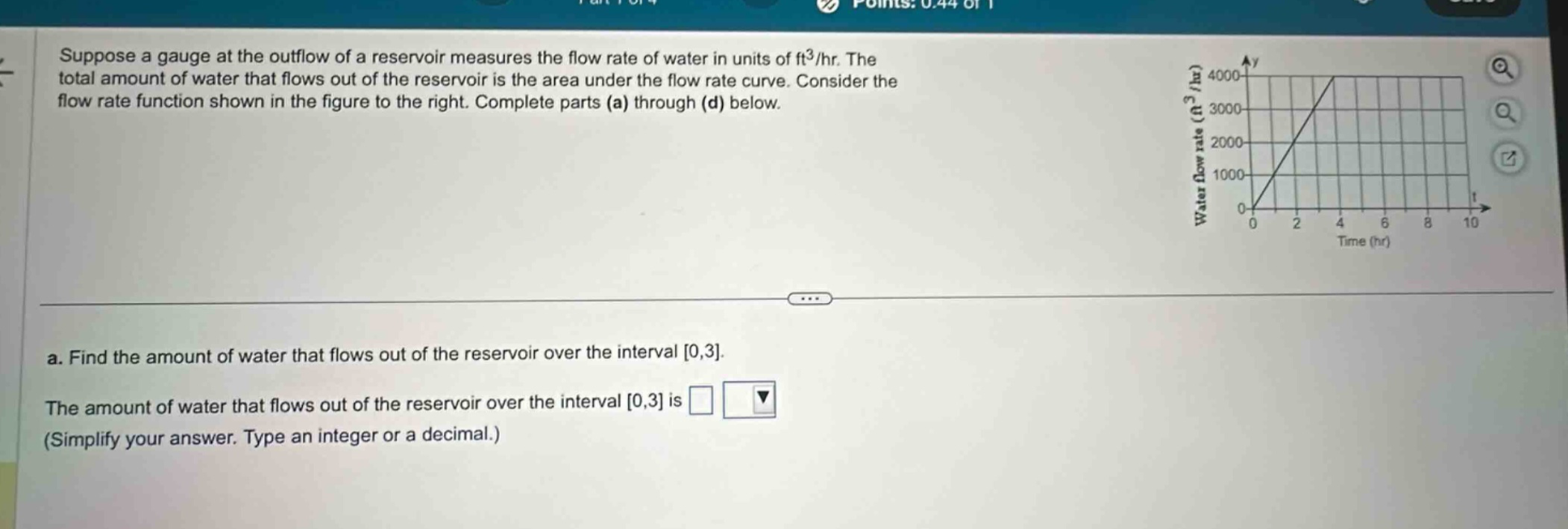
suppose a gauge at the outflow of a reservoir measures the flow rate of water in units of ft³/hr. the total amount of water that flows out of the reservoir is the area under the flow rate curve. consider the flow rate function shown in the figure to the right. complete parts (a) through (d) below. a. find the amount of water that flows out of the reservoir over the interval 0,3. the amount of water that flows out of the reservoir over the interval 0,3 is (simplify your answer. type an integer or a decimal.)
Answer
Explanation:
Step1: Identify the shape of the region
The region under the flow - rate curve from (t = 0) to (t=3) is a triangle. The formula for the area of a triangle is (A=\frac{1}{2}bh).
Step2: Determine the base and height
The base (b) of the triangle is the time interval, so (b = 3) hours. The height (h) of the triangle can be found from the graph. The flow - rate at (t = 3) is (3000) (ft^{3}/hr), so (h=3000) (ft^{3}/hr).
Step3: Calculate the area
Using the area formula (A=\frac{1}{2}bh), we substitute (b = 3) and (h = 3000). So (A=\frac{1}{2}\times3\times3000=4500) (ft^{3}).
Answer:
(4500)