suppose the graph of the parent function (y = cot(x)) is vertically compressed to produce the graph of the…
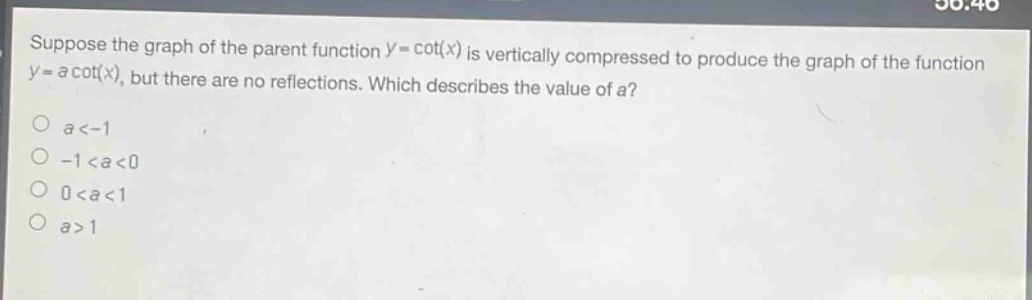
suppose the graph of the parent function (y = cot(x)) is vertically compressed to produce the graph of the function (y = acot(x)), but there are no reflections. which describes the value of (a)?\n(a < - 1)\n(-1 < a < 0)\n(0 < a < 1)\n(a>1)
Answer
Explanation:
Step1: Recall vertical - compression rule
For a function (y = f(x)) transformed to (y = a\cdot f(x)), if (|a|<1) and (a>0), the graph of (y = f(x)) is vertically compressed.
Step2: Analyze the given function
The parent function is (y=\cot(x)) and the transformed function is (y = a\cot(x)) with no reflections. For a vertical compression of (y = \cot(x)) to (y=a\cot(x)) without reflection (so (a>0)), we need (0 < a<1).
Answer:
(0 < a<1)