suppose that an insect population in millions is modeled by f(x) = (10x + 9)/(x + 3), where x≥0 is in…
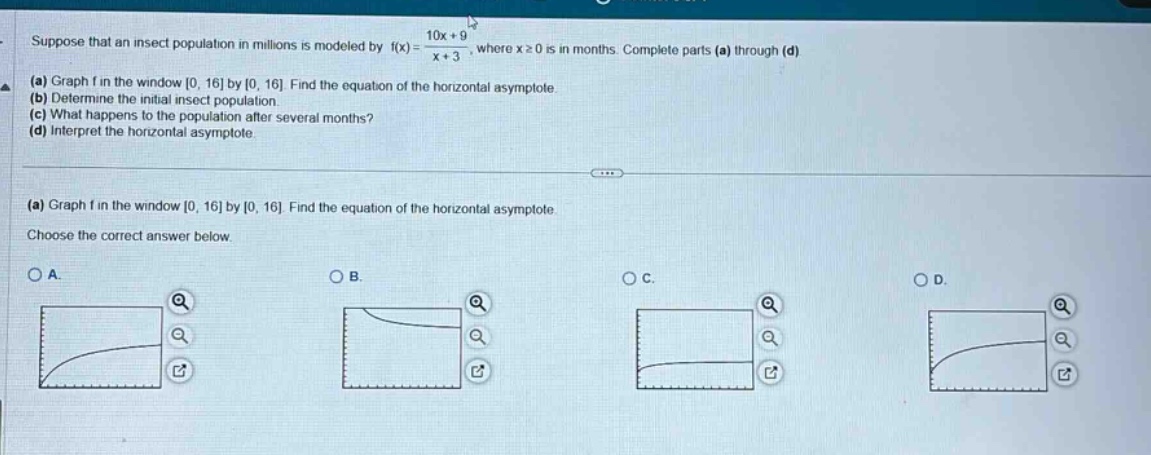
suppose that an insect population in millions is modeled by f(x) = (10x + 9)/(x + 3), where x≥0 is in months. complete parts (a) through (d)\n(a) graph f in the window 0, 16 by 0, 16. find the equation of the horizontal asymptote.\n(b) determine the initial insect population.\n(c) what happens to the population after several months?\n(d) interpret the horizontal asymptote.\n\n(a) graph f in the window 0, 16 by 0, 16. find the equation of the horizontal asymptote.\nchoose the correct answer below.\no a.\no b.\no c.\no d.
Answer
Explanation:
Step1: Find the horizontal - asymptote
For a rational function $y = \frac{f(x)}{g(x)}=\frac{10x + 9}{x + 3}$, where $f(x)=10x + 9$ and $g(x)=x + 3$ are polynomials. Since the degree of the numerator and the denominator are the same (both degree 1), the horizontal - asymptote is given by $y=\frac{a}{b}$, where $a$ is the leading coefficient of the numerator and $b$ is the leading coefficient of the denominator. Here, $a = 10$ and $b = 1$, so the horizontal - asymptote is $y = 10$.
Step2: Analyze the function behavior
As $x\to+\infty$, $f(x)=\frac{10x+9}{x + 3}=\frac{10x+30-21}{x + 3}=\frac{10(x + 3)-21}{x + 3}=10-\frac{21}{x + 3}$. As $x$ increases (after several months), $\frac{21}{x + 3}\to0$, and $f(x)\to10$.
Step3: Find the initial population
To find the initial population, we substitute $x = 0$ into the function $f(x)$. So $f(0)=\frac{10\times0+9}{0 + 3}=\frac{9}{3}=3$ (in millions).
Answer:
(a) To graph the function $y=\frac{10x + 9}{x + 3}$ in the window $[0,16]$ by $[0,16]$, we can use a graphing utility. The horizontal - asymptote is $y = 10$. (b) The initial insect population is $3$ million. The equation of the horizontal asymptote is $y = 10$. (c) After several months, the insect population approaches $10$ million. (d) The horizontal asymptote $y = 10$ represents the long - term limit of the insect population. As time (in months) goes on, the population of insects will get closer and closer to $10$ million. For the multiple - choice part about the graph, without seeing the actual graphs, we know that the function starts at $y = 3$ (when $x = 0$) and approaches $y = 10$ as $x$ increases. The graph should start at the point $(0,3)$ and have a horizontal asymptote at $y = 10$.